Spiral Galaxy Structure Explained: 8 Key Features

Spiral Galaxy Structure Explained:
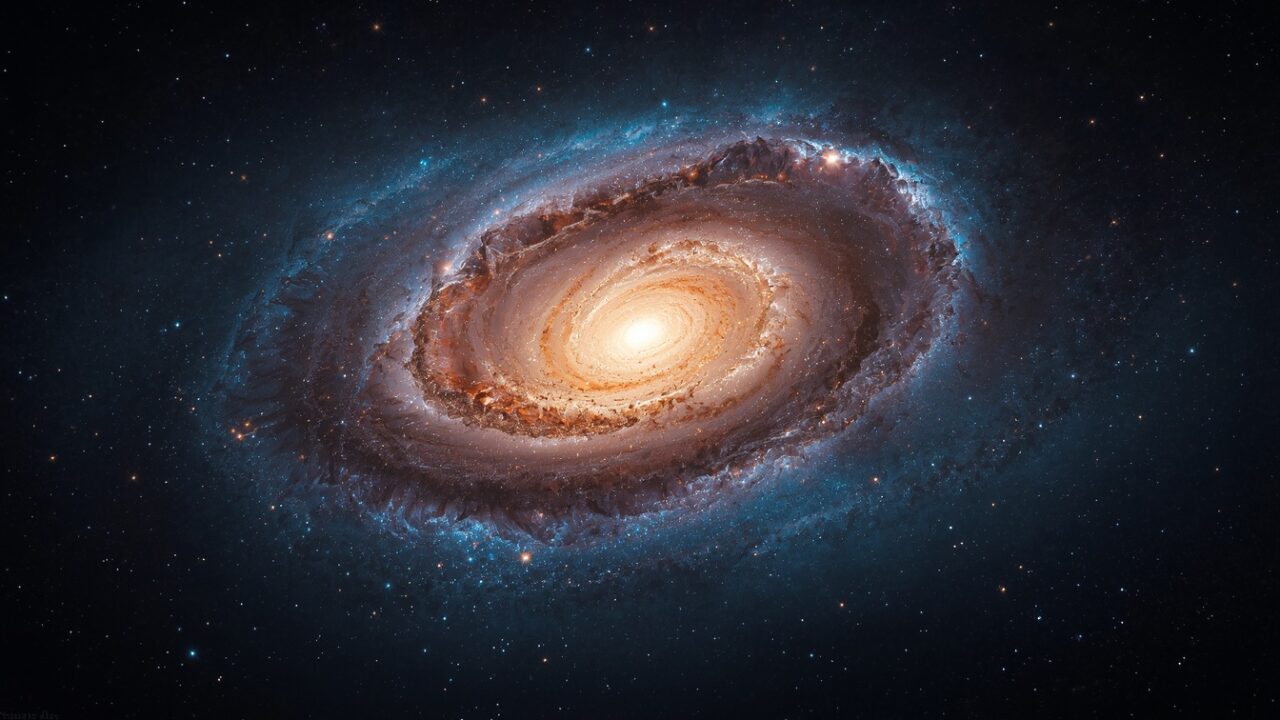
Spiral galaxies are among the most photogenic objects in deep-space imagery, and understanding their layout makes every photograph more meaningful. With Spiral galaxy structure explained clearly, readers can identify the distinct components that make up galaxies like our own Milky Way.
The Central Bulge
At the heart of most spiral galaxies lies a dense, roughly spherical concentration of older stars known as the central bulge. In Spiral galaxy structure explained through imaging, this region typically appears as the brightest, most compact area near the galaxy’s core, often housing a supermassive black hole at its very center.
Spiral Arms: The Defining Feature
The sweeping arms that give spiral galaxies their name contain young, hot stars, active star-forming regions, and significant amounts of gas and dust. These arms aren’t fixed structures but density waves — regions where gas compresses and triggers new star formation as the galaxy rotates.
The Galactic Disk
Surrounding the bulge, the flat, rotating disk contains the majority of a spiral galaxy’s stars, gas, and dust. This disk is where spiral arms are embedded, and it’s typically much thinner relative to its diameter, giving spiral galaxies their characteristic flattened, pancake-like profile when viewed edge-on.
The Halo: An Often-Overlooked Region
Extending well beyond the visible disk, the galactic halo contains older, sparsely distributed stars along with globular clusters and significant amounts of dark matter. Though difficult to photograph directly due to its faintness, the halo plays a crucial role in a galaxy’s overall gravitational structure.
Barred vs. Unbarred Spirals
Many spiral galaxies feature a straight bar-shaped structure of stars cutting through the central bulge, a variant known as a barred spiral galaxy. With Spiral galaxy structure explained in detail, these bars are thought to help funnel gas toward the galactic center, potentially fueling central black hole activity and star formation.
How Rotation Shapes the Spiral Pattern
Spiral arms form due to differential rotation — the inner regions of a galaxy rotate faster than the outer regions, gradually winding gas and stars into the characteristic spiral pattern observed in telescope images, a process that continues shaping the galaxy over billions of years.
Dust Lanes Within the Arms
Dark dust lanes often trace the inner edges of spiral arms, visible in high-resolution photography as dark bands cutting through otherwise bright regions. These lanes mark areas of dense gas and dust actively collapsing to form new stars.
Classifying Spiral Galaxies
Astronomers use the Hubble sequence to classify spiral galaxies based on how tightly wound their arms appear and the relative size of their central bulge, ranging from tightly wound Sa-type galaxies to loosely wound Sc-type galaxies with smaller bulges.
Density Waves: Why the Arms Don’t Wind Up
If spiral arms were fixed groups of stars, the galaxy’s rotation would wind them tighter and tighter until they disappeared. Stars near the center orbit faster than stars farther out, so the pattern would smear out within a few rotations. Yet spiral galaxies keep their arms for billions of years.
The leading explanation is density wave theory. The arms are regions where stars and gas bunch up temporarily as they move through them, much like a traffic jam on a highway. Cars pass through the jam, but the jam itself persists. Stars and gas slow down in the arms, compress, and then move on, while the pattern stays in place.
Grand Design Versus Flocculent Spirals
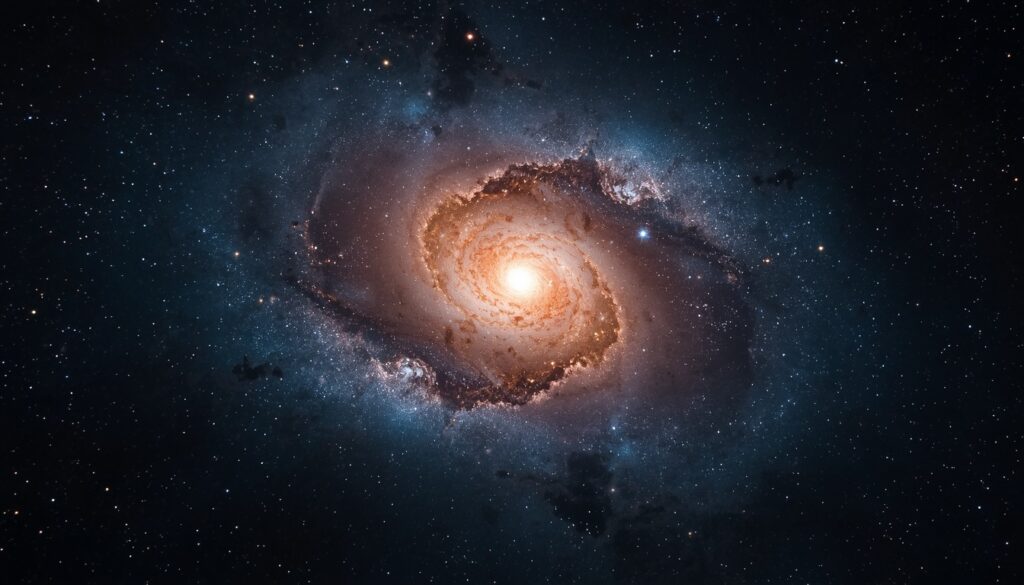
Not all spirals look alike. Grand design spirals, such as the Whirlpool Galaxy (M51), have two clear, continuous arms that sweep across the disk. These are often linked to interactions with a companion galaxy, which can help drive strong density waves.
Flocculent spirals, like NGC 2841, have patchy, broken arm segments instead of long continuous arms. Their structure is thought to come more from local star formation than from a large-scale wave. Spiral galaxy structure explained in textbooks usually shows the grand design version, but flocculent spirals are actually very common.
Why the Arms Look Blue in Photographs
The arms stand out in images because they are lit up by young, hot, massive stars. These stars shine blue-white and are extremely bright, but they live only a few million years, so they never travel far from where they formed. That keeps the blue glow concentrated along the arms.
Pink patches along the arms are emission nebulae where new stars are forming. Between the arms, older, cooler stars still exist, but they are less bright, so the gaps appear darker. The central bulge usually looks yellow because it is dominated by older stars.
Our Own Galaxy as a Spiral
The Milky Way is a barred spiral galaxy, although we can never photograph it from the outside. Astronomers map its structure by measuring the positions and motions of stars, gas clouds and star-forming regions, using radio and infrared observations that see through the dust in the disk.
The Sun sits in a minor arm known as the Orion Spur, about 26,000 light-years from the center. The Gaia mission has greatly improved maps of our galaxy by measuring precise positions and motions for more than a billion stars, helping astronomers refine how many major arms the Milky Way has.
Good Spirals to Observe and Photograph
Several bright spirals are within reach of backyard telescopes. The Andromeda Galaxy (M31) is the largest and easiest, though it appears tilted. The Whirlpool Galaxy (M51) shows its arms well in medium telescopes under dark skies, and the Pinwheel Galaxy (M101) is a large face-on spiral that rewards long-exposure photography.
For a barred example, try M95 in Leo or the beautiful NGC 1300 in Eridanus for southern observers. Capturing the arms usually requires stacking many exposures, because the faint outer regions are much dimmer than the bright core.
Lenticular Galaxies: The In-Between Type
Between spirals and ellipticals sit lenticular galaxies, classified as S0. They have a central bulge and a flat disk like spirals, but little or no visible arm structure and very little star formation. Many astronomers think some lenticulars are former spirals that lost their gas, often in crowded galaxy clusters where gas can be stripped away. The Spindle Galaxy (NGC 5866) is a well-known example seen edge-on.
Final Thoughts
With Spiral galaxy structure explained through these core components — bulge, arms, disk, and halo — even casual observers can better appreciate the complex physics behind every spiral galaxy photograph, transforming a simple pretty picture into a window on galactic dynamics.
Keep exploring with our guides to Milky Way galaxy structure images, Hubble Whirlpool Galaxy photos and Elliptical galaxy visual guide. For official information, visit NASA’s universe science hub.
Frequently Asked Questions
What is at the center of a spiral galaxy?
A dense central bulge, often housing a supermassive black hole.
Why do spiral arms appear brighter than other regions?
They contain young, hot stars and active star-forming regions.
What is a barred spiral galaxy?
A spiral galaxy with a straight bar-shaped structure of stars crossing its central bulge.
What is the galactic halo?
An outer region containing old stars, globular clusters, and dark matter surrounding the visible disk.
How are spiral galaxies classified?
Using the Hubble sequence, based on arm tightness and bulge size, ranging from Sa to Sc types.


1 comment