6 Amazing Details in the Hubble Sombrero Galaxy Image


The Hubble Sombrero Galaxy Image:
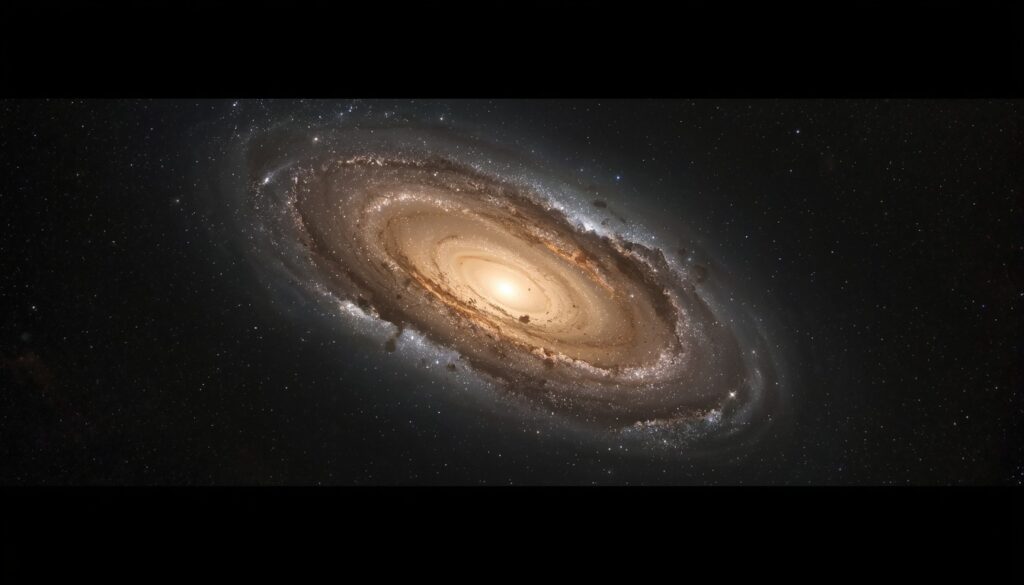
Few galaxies are as visually distinctive as Messier 104, better known through the Hubble Sombrero Galaxy image that made it famous worldwide. Located approximately 28 million light-years away in the constellation Virgo, this galaxy earned its nickname from its resemblance to a wide-brimmed hat, complete with a bright central bulge and a dark dust lane forming the “brim.”
The Iconic Dust Lane
The most recognizable feature in the Hubble Sombrero Galaxy image is the thick, dark band of dust encircling the galaxy’s bright core. This dust lane is made up of gas and dust that has yet to form new stars, silhouetted dramatically against the glowing light of billions of older stars behind it.
An Unusually Large Central Bulge
Unlike typical spiral galaxies, the Sombrero Galaxy features an oversized central bulge that dominates its structure. The Hubble Sombrero Galaxy image clearly shows this bright, densely packed core, which some astronomers believe may represent a transitional galaxy type between standard spirals and giant elliptical galaxies.
A Massive Black Hole at Its Center
Observations tied to Hubble Sombrero Galaxy image data suggest the galaxy harbors a supermassive black hole at its core, estimated to be roughly a billion times the mass of our Sun — one of the more massive black holes measured in relatively nearby galaxies.
A Halo of Globular Clusters
Beyond its glowing disk, the Sombrero Galaxy is surrounded by an unusually large number of globular star clusters — dense groupings of ancient stars. Estimates suggest nearly 2,000 such clusters orbit within its halo, visible as faint points scattered around the galaxy in wide-field versions of the image.
Combining Visible and Infrared Data
Later versions of the Hubble Sombrero Galaxy image combined visible light data with infrared observations from the Spitzer Space Telescope, revealing that the dust lane actually forms a complete ring around the galaxy rather than a simple flat band, a detail not obvious in visible light alone.
A Favorite Target for Amateur Astronomers
Thanks to its brightness and distinctive shape, the Sombrero Galaxy remains one of the most popular deep-sky targets for amateur astrophotographers, often used as a benchmark image to test telescope and camera setups due to its relatively easy visibility even from mid-sized backyard telescopes.
Classification Debates Among Astronomers
The unusual structure captured in the image has led to ongoing debate about its precise classification — some studies suggest it may actually be a giant elliptical galaxy with an embedded disk, rather than a true spiral galaxy, highlighting how even well-photographed galaxies can still hold scientific mysteries.
Why This Image Remains a Favorite
Its symmetry, brightness, and dramatic contrast between the glowing bulge and dark dust lane make the Sombrero Galaxy one of the most aesthetically striking objects in deep-space photography, regularly featured in astronomy publications and educational materials.
Finding the Sombrero With a Backyard Telescope
The Sombrero Galaxy, also known as Messier 104, sits about 28 to 31 million light-years away on the border between the constellations Virgo and Corvus. It shines at around magnitude 8, which means it can be spotted with binoculars under dark skies and is a rewarding target for small telescopes.
In a 6- or 8-inch telescope, the bright central bulge is easy to see, and on a steady night the dark dust lane appears as a thin line cutting across it. It is best observed in spring from the Northern Hemisphere. Photographers can capture the dust lane clearly with modest equipment, although matching the detail of the image requires far larger instruments.
How Hubble Built the Famous Mosaic
The well-known 2003 Hubble portrait of the Sombrero is not a single snapshot. It is a mosaic of several fields captured with the Advanced Camera for Surveys and stitched together to cover the full width of the galaxy at high resolution. The final image was large enough to be printed in huge formats without losing detail.
The mosaic approach explains why the image looks so sharp from edge to edge. It also revealed many faint globular clusters in the galaxy’s halo, which appear as tiny points of light surrounding the bright bulge.
What Webb Revealed Later
In 2024, NASA released new Webb images of the Sombrero taken in mid-infrared light with MIRI. In that view, the bright glow of the central bulge nearly disappears, and the outer dust ring becomes the main feature. The ring looks clumpy, and the data suggested it contains the kind of dust particles associated with star formation.
Comparing the Hubble and Webb versions is a good lesson in how wavelength changes perception. Hubble shows the stars and the silhouette of the dust lane against them. Webb shows the dust itself glowing, turning the dark lane from Hubble’s view into the brightest part of the picture.
Why the Galaxy Looks Like a Hat
The Sombrero’s shape comes from our viewing angle. We see it almost edge-on, tilted only a few degrees from flat. From this angle, the dust ring appears as a narrow band while the round central bulge sticks out above and below it, creating the brim-and-crown effect that gave the galaxy its name.
If we viewed it from above, it would likely look like a very different object, with the ring appearing as a broad circular band around a bright center. Many galaxies look dramatically different depending on their orientation, which is one reason astronomers study large samples to understand galaxy structure.
A Galaxy Moving Away From Us
In the early twentieth century, the Sombrero played a role in one of astronomy’s biggest discoveries. Vesto Slipher measured its spectrum and found that it was moving away from us at roughly 1,000 kilometers per second, far faster than stars in our galaxy move.
That extreme speed was one of the early clues that spiral nebulae like the Sombrero were separate galaxies far beyond the Milky Way. Combined with later distance measurements by Edwin Hubble and others, observations like Slipher’s led to the discovery that the universe is expanding.
When you look at a modern image of the Sombrero, you are seeing one of the objects that helped establish the scale and history of the cosmos.
Distance Estimates and Why They Vary
Published distances for the Sombrero range from about 28 to 31 million light-years, depending on the method used. Astronomers compare techniques such as the brightness of its globular clusters and fluctuations in its surface brightness, and each method carries its own uncertainty.
Final Thoughts
The image combines scientific significance with visual elegance, offering both a stunning photograph and a genuinely puzzling astronomical object that continues to challenge simple galaxy classification systems.
Keep exploring with our guides to Milky Way galaxy structure images, Spiral galaxy structure explained and Globular star cluster visual guide. For official information, visit NASA’s Hubble Space Telescope page.
Frequently Asked Questions
Why is it called the Sombrero Galaxy?
Its bright bulge and dark dust lane resemble the shape of a wide-brimmed hat.
How far away is the Sombrero Galaxy?
It’s located about 28 million light-years from Earth in the constellation Virgo.
Does it have a black hole at its center?
Yes, observations suggest a supermassive black hole roughly a billion solar masses.
How many globular clusters surround it?
Estimates suggest nearly 2,000 globular clusters orbit within its halo.
Is it a spiral or elliptical galaxy?
Its classification is debated — it shows features of both spiral and giant elliptical galaxies.



1 comment