7 Breathtaking Hubble Butterfly Nebula Photos

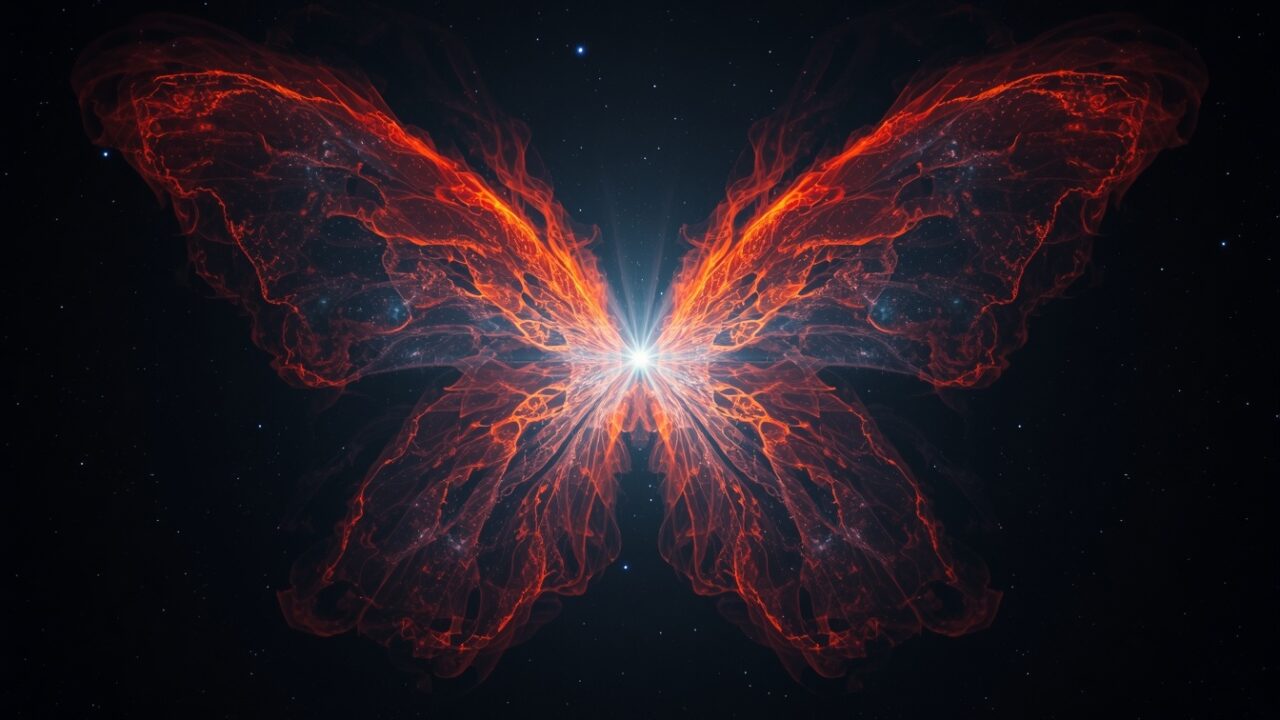
Hubble Butterfly Nebula Photos:
Among the most visually symmetrical objects captured by the telescope, Hubble Butterfly Nebula photos showcase NGC 6302, a planetary nebula located roughly 3,800 light-years away in the constellation Scorpius. Its dramatic, wing-like lobes of glowing gas gave the object its popular nickname — the Butterfly Nebula.
A Dying Star’s Final Act
Planetary nebulae like this one form when a dying star sheds its outer layers, and Hubble Butterfly Nebula photos captured this process in extraordinary detail. At the nebula’s center lies one of the hottest known stars, with surface temperatures estimated at over 200,000 degrees Celsius, driving the intense radiation that makes the surrounding gas glow so vividly.
The Butterfly-Wing Structure
The nebula’s two symmetrical lobes, resembling butterfly wings, extend across roughly two light-years of space. Hubble Butterfly Nebula photos reveal intricate patterns within these wings, including ripples, knots, and filaments formed as expanding gas interacts with material from earlier stages of the star’s stellar evolution.
Color Mapping and Chemical Composition
The vivid colors seen in Hubble Butterfly Nebula photos represent different chemical elements within the nebula’s gas, captured through specific filters and later combined into the final composite image. Oxygen, nitrogen, and sulfur emissions each contribute distinct color signatures, helping astronomers map the nebula’s chemical structure.
A Hidden Dust Disk
At the very center of the nebula, hidden from direct view, astronomers believe a dense torus of dust surrounds the dying central star, helping to shape and direct the outflowing gas into its distinctive two-lobed structure rather than a simple spherical shell.
Comparing Earlier and Later Versions
Hubble Butterfly Nebula photos have been updated over the years as instrument technology improved, with later versions using Wide Field Camera 3 offering significantly sharper detail and wider color range compared to earlier observations, allowing astronomers to study fine structural changes within the nebula more precisely.
Temperature Extremes Within the Nebula
Studies based on these photos revealed some of the most extreme temperature variations known within a planetary nebula, ranging from relatively cool outer gas regions to superheated material near the central star, offering valuable insight into the physics of stellar death processes.
A Popular Target for Astrophotographers
While the full detail seen in Hubble’s version requires space-based imaging, amateur astrophotographers with mid-to-large telescopes often attempt to capture simplified versions of the Butterfly Nebula, using it as a benchmark object for testing narrowband imaging filters targeting oxygen and hydrogen emissions.
What This Nebula Teaches About Stellar Death
Studying objects like this helps astronomers understand what will eventually happen to stars similar in mass to our Sun, offering a preview of the dramatic, colorful transformation stars undergo in their final life stages before settling into a slowly cooling white dwarf remnant.
The Real Name and Location of the Butterfly
The Butterfly Nebula is cataloged as NGC 6302, and it sits roughly 3,500 to 4,000 light-years away in the constellation Scorpius. It is sometimes also called the Bug Nebula. Because it lies low in the sky for northern observers, it is easier to photograph from southern latitudes, where Scorpius climbs high overhead.
The most famous version of the came in 2009, shortly after astronauts installed the Wide Field Camera 3 during the final servicing mission. The image was released as part of a set showing off the upgraded telescope’s capabilities.
The Extremely Hot Central Star
At the center of NGC 6302 sits one of the hottest known stars at the heart of a planetary nebula, with surface temperatures estimated at over 200,000 degrees Celsius. Despite that, it was difficult to see directly for many years because a thick disk of dust surrounds it and blocks its light from our line of sight.
This star is the exposed core of a star that was once several times more massive than the Sun. Its intense ultraviolet radiation makes the surrounding gas glow, which is what produces the colorful wings visible in the images.
Speed of the Expanding Wings
The gas in the butterfly’s wings is moving outward at remarkable speeds, with some material estimated to be traveling at more than 950,000 kilometers per hour. At that rate, the wings are growing noticeably on astronomical timescales, and repeated observations can track their expansion.
By measuring how fast the gas is moving and how far it has traveled, astronomers can estimate when the outflow began. Studies suggest the current wings formed within the last couple of thousand years, which makes NGC 6302 a relatively young planetary nebula.
Photographing the Butterfly From Earth
Amateur astrophotographers can capture NGC 6302, but it is a challenging target. The bright core and faint wings demand careful exposure, and narrowband filters for hydrogen-alpha and oxygen emission help separate the nebula from the sky background. Longer focal lengths are needed because the nebula is small on the sky.
Southern Hemisphere observers have a clear advantage, since the nebula climbs higher and passes through less atmosphere. Even with a good amateur setup, the result will look very different from Hubble’s view, but it can still show the distinctive two-lobed shape that gives the nebula its name.
Webb’s Look at the Butterfly
In 2025, researchers released new Webb observations of NGC 6302 that looked deep into its dusty center. Using infrared light, the telescope could see through much of the dust that blocks visible light and study the torus surrounding the central star.
The data revealed a mix of dust grains, including crystalline silicates, and complex carbon-based molecules. These observations help explain how dying stars enrich their surroundings with material that later becomes part of new stars and planets.
Taken together, Hubble’s visible-light portrait and Webb’s infrared view show the Butterfly Nebula as both a beautiful object and a working laboratory for the life cycle of stars. It is one of the best places in the sky to watch a star recycle its material back into the galaxy.
Why Planetary Nebulae Are Short-Lived
On cosmic timescales, planetary nebulae like the Butterfly last only briefly, usually tens of thousands of years. The expanding gas eventually thins out and fades into the interstellar medium, while the central star cools into a white dwarf. That short window is why we see only a limited number of them at any one time.
A Quick Viewing Tip
If you want to see the Butterfly yourself, try a telescope of 8 inches or more under dark southern skies. It will look small and gray, but an oxygen-III filter can make its two lobes easier to spot.
Final Thoughts
These photos remain some of the most detailed and colorful planetary nebula images ever captured, offering both visual spectacle and valuable scientific insight into the life cycles of stars.
Keep exploring with our guides to Planetary nebula formation visual guide, Ring Nebula visual guide and James Webb Southern Ring Nebula. For official information, visit NASA’s Hubble Space Telescope page.
Frequently Asked Questions
What is the Butterfly Nebula?
A planetary nebula, cataloged as NGC 6302, formed by a dying star shedding its outer gas layers.
How far away is it from Earth?
It’s located approximately 3,800 light-years away in the constellation Scorpius.
Why does it have a butterfly shape?
A hidden dust torus around the central star directs outflowing gas into two symmetrical lobes.
What causes the different colors in the image?
Different chemical elements like oxygen, nitrogen, and sulfur emit distinct colors under specific imaging filters.
How hot is the central star?
Estimates suggest surface temperatures exceeding 200,000 degrees Celsius, among the hottest known stars.
1 comment