Hubble Deep Field Image Explained: 10 Astonishing Facts

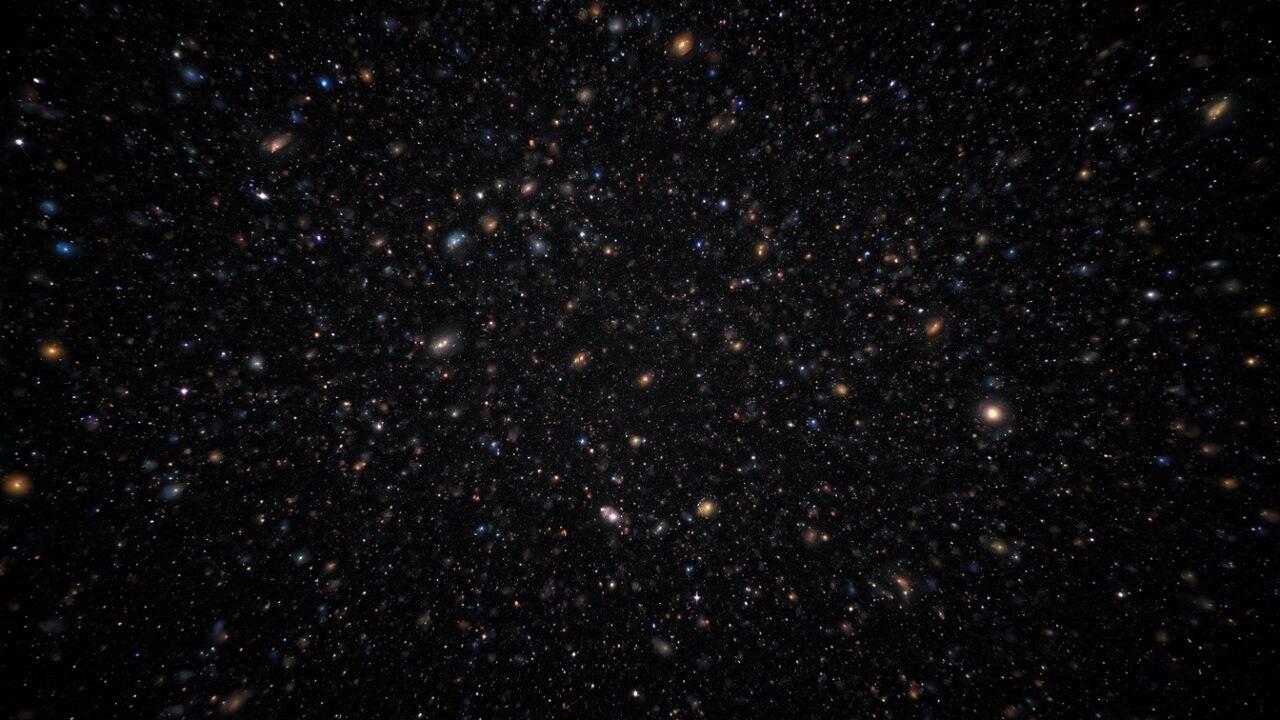
Hubble Deep Field Image Explained:
In 1995, astronomers pointed the Hubble Space Telescope at what appeared to be an empty patch of sky and left the shutter open for ten consecutive days. The result reshaped our understanding of the universe. The Hubble Deep Field image explained here isn’t just a photograph — it’s one of the most important scientific images ever produced, revealing roughly 3,000 galaxies in a region of sky no larger than a grain of sand held at arm’s length.
Choosing an “Empty” Patch of Sky
Astronomer Robert Williams selected a small area near the Big Dipper that seemed free of bright stars or nearby galaxies. Skeptics questioned the decision, believing the exposure would reveal nothing. Instead, when the Hubble Deep Field image was released, it stunned the scientific community by showing an almost unimaginable density of distant galaxies packed into that tiny frame.
How the Image Was Captured
Hubble took 342 separate exposures over 10 consecutive days, all aimed at the same coordinates. Combining these long exposures allowed extremely faint, distant light to accumulate on the telescope’s sensor. This technique is central to understanding the Hubble Deep Field image explained from a technical standpoint — deep field photography relies on patience, not power, letting faint ancient light build up gradually.
What the Galaxies Actually Show
Each smudge of light in the image is an entire galaxy, some containing billions of stars. Because light takes time to travel, many of these galaxies appear as they existed billions of years ago — some fragments date back to within a billion years of the Big Bang itself. This makes the Hubble Deep Field image less a snapshot of “now” and more a time capsule of the early universe.
The Shapes Tell a Story
Astronomers studying the image noticed an unusual variety of galaxy shapes — spirals, ellipticals, and strange, irregular blobs that don’t resemble galaxies in our local universe. These irregular shapes are believed to represent galaxies in earlier, more chaotic stages of formation, before they settled into the more organized spiral and elliptical structures we see nearby today.
Follow-Up Deep Field Images
The success of the original led to several follow-ups, including the Hubble Ultra Deep Field and eventually deep field images captured by the James Webb Space Telescope. Each successive image pushed further back in cosmic time, and comparing them helps astronomers trace how galaxies evolved in size, shape, and star-formation activity across billions of years.
Why This Image Changed Astronomy
Before this experiment, many scientists assumed that a random patch of “blank” sky would show little more than a handful of foreground stars. The Hubble Deep Field image explained the opposite — that no direction in the sky is truly empty, and that the universe is far more densely populated with galaxies than previously imagined. This single insight influenced decades of subsequent research into galaxy formation and cosmic evolution.
A Tool for Estimating the Universe’s Scale
By extrapolating the galaxy density seen in this tiny patch across the entire sky, astronomers arrived at estimates suggesting the observable universe contains hundreds of billions of galaxies. It remains one of the most cited justifications for that staggering figure, making the image not just visually stunning but foundational to how we quantify the cosmos.
Legacy in Public Imagination
Beyond its scientific value, the Hubble Deep Field image has become a cultural touchstone — a humbling reminder of scale, often used in documentaries, books, and classrooms to illustrate just how vast and populated the universe truly is.
The Gamble Behind the Observation
It is easy to forget how risky the original Deep Field was. Hubble observing time is heavily oversubscribed, and in 1995 Space Telescope Science Institute director Robert Williams chose to spend part of his discretionary time pointing the telescope at a tiny, seemingly blank patch of sky near the Big Dipper for about ten days. Critics worried the result might show almost nothing, wasting some of the most valuable telescope time in the world.
Instead, the observation revealed roughly 3,000 galaxies in a region about the width of a tennis ball seen from 100 meters away. The bet paid off so well that deep, long-exposure surveys became a standard tool of modern astronomy, and the data were released publicly almost immediately so researchers everywhere could use them.
Reading the Colors and the Faintest Smudges
The Hubble Deep Field image explained in simple terms is a stack of exposures taken through four filters, from ultraviolet to near-infrared, combined into one color picture. The colors are close to what the human eye would see if it were vastly more sensitive, although some redder objects appear that way because of distance rather than true color.
That redness is the key to reading the image. As light travels across an expanding universe, it is stretched to longer wavelengths, an effect called redshift. The smallest, reddest smudges are generally the most distant galaxies, seen as they were when the universe was only a fraction of its current age. The large spirals and ellipticals in the foreground are much closer, so a single frame holds billions of years of cosmic history layered on top of each other.
Stars, Galaxies and a Few Surprises
Almost every point of light in the Deep Field is a galaxy. Only a small number of foreground stars from our own Milky Way appear, and they are easy to recognize by the sharp diffraction spikes Hubble’s optics create around bright point sources. Galaxies, by contrast, look soft and extended.
Researchers who combed through the image found many galaxies with irregular, lumpy shapes and signs of recent collisions. Those features were much more common than in the nearby universe, which supported the idea that galaxies grew over time through mergers. That single observation gave astronomers a statistical sample of early galaxies that simply did not exist before.
The Deep Field’s Southern Twin
In 1998, Hubble repeated the experiment in the southern sky with the Hubble Deep Field South, pointing at a patch in the constellation Tucana. Astronomers wanted to know whether the original result was a lucky accident or a fair sample of the universe.
The southern field looked remarkably similar, with a comparable number and variety of distant galaxies. That similarity was strong evidence that the universe looks roughly the same in every direction on large scales, an assumption known as the cosmological principle that underpins modern cosmology.
Final Thoughts
The Deep Field image in full context is a lesson in scientific patience and curiosity. A ten-day stare into apparent nothingness uncovered thousands of galaxies and permanently altered how astronomers approach the concept of “empty” sky.
Keep exploring with our guides to Hubble Deep Field photo story, Hubble Ultra Deep Field galaxies and James Webb galaxy cluster SMACS 0723. For official information, visit NASA’s Hubble Space Telescope page.
Frequently Asked Questions
What is the Hubble Deep Field image?
It’s a 1995 long-exposure photograph revealing roughly 3,000 previously unseen galaxies in a tiny “empty” patch of sky.
How long did Hubble expose the image?
Hubble captured 342 exposures over 10 consecutive days to gather enough faint light.
Why did astronomers choose an empty-looking area?
To test whether even blank-seeming sky contained distant galaxies — and it did, in huge numbers.
What do the different galaxy shapes mean?
Irregular shapes suggest galaxies in earlier, more chaotic formation stages compared to modern spiral and elliptical galaxies.
Did this image lead to other deep field photos?
Yes, it inspired the Hubble Ultra Deep Field and later James Webb deep field images, pushing observations even further back in time.
1 comment