5 Fascinating Facts in This Ring Nebula Visual Guide

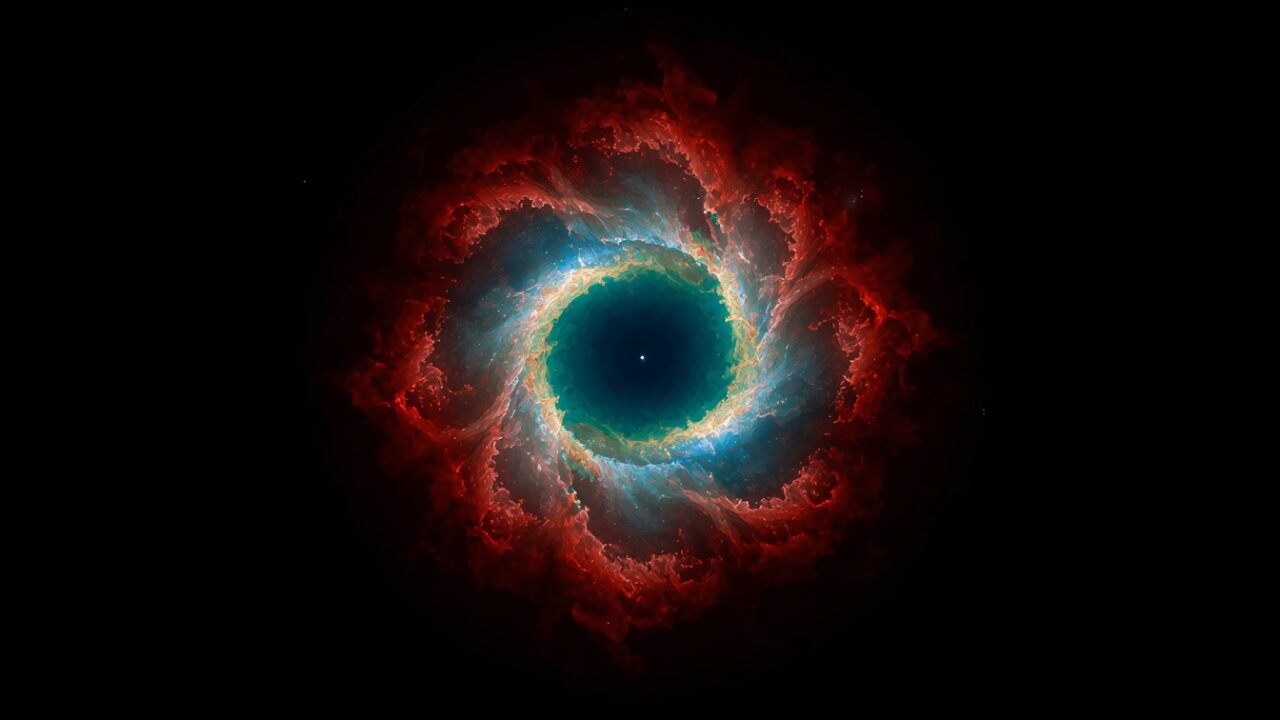
Ring Nebula Visual Guide:
Among the most recognizable planetary nebulae in the night sky, the Ring Nebula offers a perfect visual example of stellar death and transformation. This Ring Nebula visual guide breaks down what makes Messier 57 such a popular target for both professional and amateur astrophotographers.
A Glowing Ring in Lyra
Located in the constellation Lyra, roughly 2,600 light-years from Earth, the Ring Nebula appears as a glowing, donut-shaped structure in telescope images. This Ring Nebula visual guide identifies its distinct circular shape as one of the clearest, most symmetrical examples of a planetary nebula visible from Earth.
How the Ring Formed
Like other planetary nebulae, the Ring Nebula formed when a dying, Sun-like star shed its outer layers into space. The apparent ring shape likely results from viewing a roughly barrel or hourglass-shaped structure directly along its axis, making it appear as a simple ring from Earth’s perspective.
The Central White Dwarf
At the heart of the Ring Nebula lies the exposed remnant of the original star’s core — a small, incredibly hot white dwarf. This central star’s intense ultraviolet radiation ionizes the surrounding ejected gas, producing the nebula’s characteristic glow visible in detailed astrophotography.
Color Variations Across the Ring
This Ring Nebula visual guide highlights distinct color zones within the structure — typically showing blue-green tones near the center, transitioning to red and pink hues toward the outer edges, reflecting different ionization states of oxygen, hydrogen, and nitrogen gas at varying distances from the central star.
Deeper Structure Revealed by Modern Telescopes
While earlier photographs showed a relatively simple ring shape, more advanced imaging from Hubble and other telescopes revealed additional structural details, including faint outer halos and complex filament patterns not visible in earlier, lower-resolution observations.
A Favorite Target for Amateur Astrophotographers
Thanks to its brightness and relatively compact size, the Ring Nebula remains one of the most popular deep-sky targets for amateur astrophotographers, often used as a benchmark object for testing telescope resolution and color-capture capabilities.
Estimated Age and Future
Astronomers estimate the Ring Nebula formed within the last few thousand years and will continue expanding and fading over the coming millennia, eventually dispersing into the surrounding interstellar medium as its central white dwarf slowly cools.
Comparing to Other Planetary Nebulae
While many planetary nebulae display complex, asymmetric shapes, the Ring Nebula’s relatively simple, symmetrical appearance makes it an excellent introductory example for understanding basic planetary nebula formation and structure.
A Donut or a Barrel?
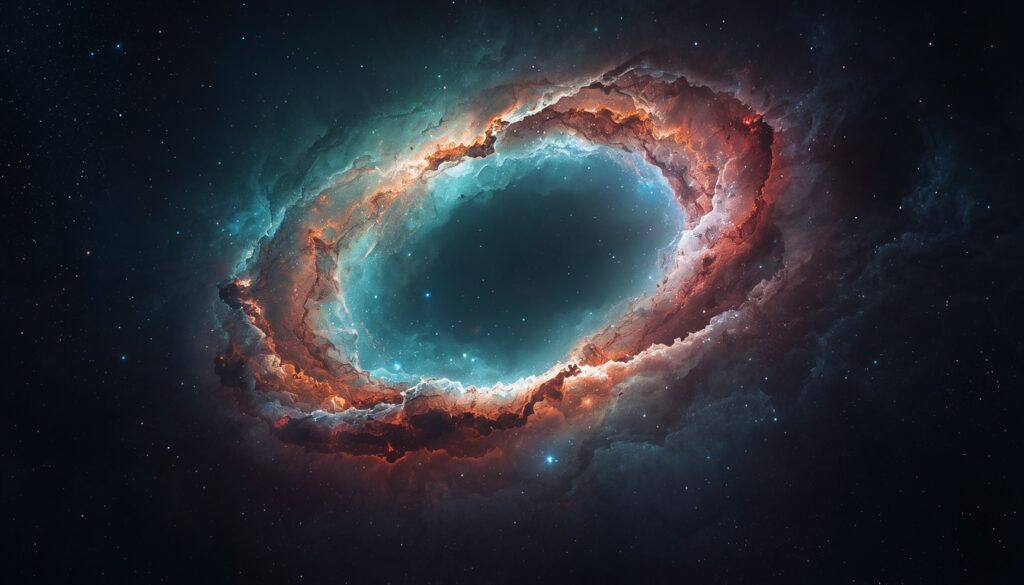
For a long time, astronomers debated the true shape of the Ring Nebula. Seen from Earth, it looks like a ring, but its three-dimensional shape is more complex. Studies suggest it is shaped more like a football or barrel with a thinner central region, and we happen to be looking down its long axis.
This viewing angle explains the ring appearance. Looking along the axis, the edges of the barrel appear brighter because we see through more glowing gas, while the center appears dimmer. A Ring Nebula visual guide that only describes a flat ring leaves out this important detail.
Webb’s 2023 Images
In August 2023, astronomers released new Webb images of the Ring Nebula taken with NIRCam and MIRI. The images revealed roughly 20,000 dense clumps of gas within the ring and about ten faint concentric arcs in the outer halo.
Those arcs may be linked to a companion star orbiting the central white dwarf, shaping the ejected material as it spiraled outward. The Webb images also showed complex molecules at the edges of the ring, giving new insight into the chemistry of dying stars.
How to Find the Ring in the Sky
The Ring Nebula, also known as Messier 57, sits in the small constellation Lyra, between the stars Beta and Gamma Lyrae. It is easy to locate once you find Vega, one of the brightest stars in the summer sky.
In a small telescope, it looks like a tiny smoke ring, and it is one of the few planetary nebulae where the ring shape is visible even at low magnification. Larger telescopes can show its slightly oval outline, though the faint central star is difficult to see visually.
Distance and Size
The Ring Nebula lies about 2,500 to 2,600 light-years away. At that distance, the glowing ring spans roughly one light-year across. Despite its small appearance in a telescope, it is large enough to contain many solar systems.
The nebula continues to expand, and repeated observations over decades have measured its growth. By comparing its size and expansion speed, astronomers estimate that the material began leaving the dying star several thousand years ago.
Imaging Tips for Photographers
The Ring is small, so photographers need a long focal length, typically 1,000 millimeters or more, to capture detail. Its brightness allows relatively short exposures, which helps reduce blurring from tracking errors.
Narrowband imaging with hydrogen-alpha and oxygen-III filters brings out the color differences between the inner and outer regions. Deep exposures can reveal the faint outer halo, a detail missing from many quick images of the nebula.
The Central Star Up Close
The white dwarf at the center of the Ring Nebula is faint, around 15th magnitude, and difficult to see even in large amateur telescopes. It has a surface temperature estimated at more than 100,000 degrees Celsius, and its ultraviolet light is what makes the ring glow.
The star was once several times more massive than the Sun before shedding its outer layers. Webb’s images helped study the environment around this star, including possible signs of a companion.
Common Misconceptions About the Ring
Some people assume the Ring Nebula is an explosion remnant like a supernova. It is actually the gentle shedding of a star’s outer layers, a much less violent process. Another common assumption is that the ring is flat, when in fact it is a three-dimensional shape viewed from a particular angle, as modern studies have shown.
Final Thoughts
This Ring Nebula visual guide demonstrates how a seemingly simple glowing ring actually represents a complex, three-dimensional structure shaped by stellar death, offering both visual beauty and valuable insight into the life cycle of Sun-like stars.
Keep exploring with our guides to Planetary nebula formation visual guide, Hubble Butterfly Nebula photos and Helix Nebula eye of God image. For official information, visit NASA’s universe science hub.
Frequently Asked Questions
What is the Ring Nebula?
A planetary nebula, cataloged as Messier 57, formed by a dying star shedding its outer gas layers.
How far away is the Ring Nebula?
Approximately 2,600 light-years, located in the constellation Lyra.
Why does it appear as a simple ring?
We’re likely viewing a barrel or hourglass-shaped structure directly along its axis.
What’s at the center of the Ring Nebula?
A small, extremely hot white dwarf star, the remnant of the original star’s core.
Why do the colors vary across the ring?
Different ionization states of oxygen, hydrogen, and nitrogen create distinct color zones.
Keep exploring