8 Incredible Hubble Eagle Nebula Photos and What They Reveal

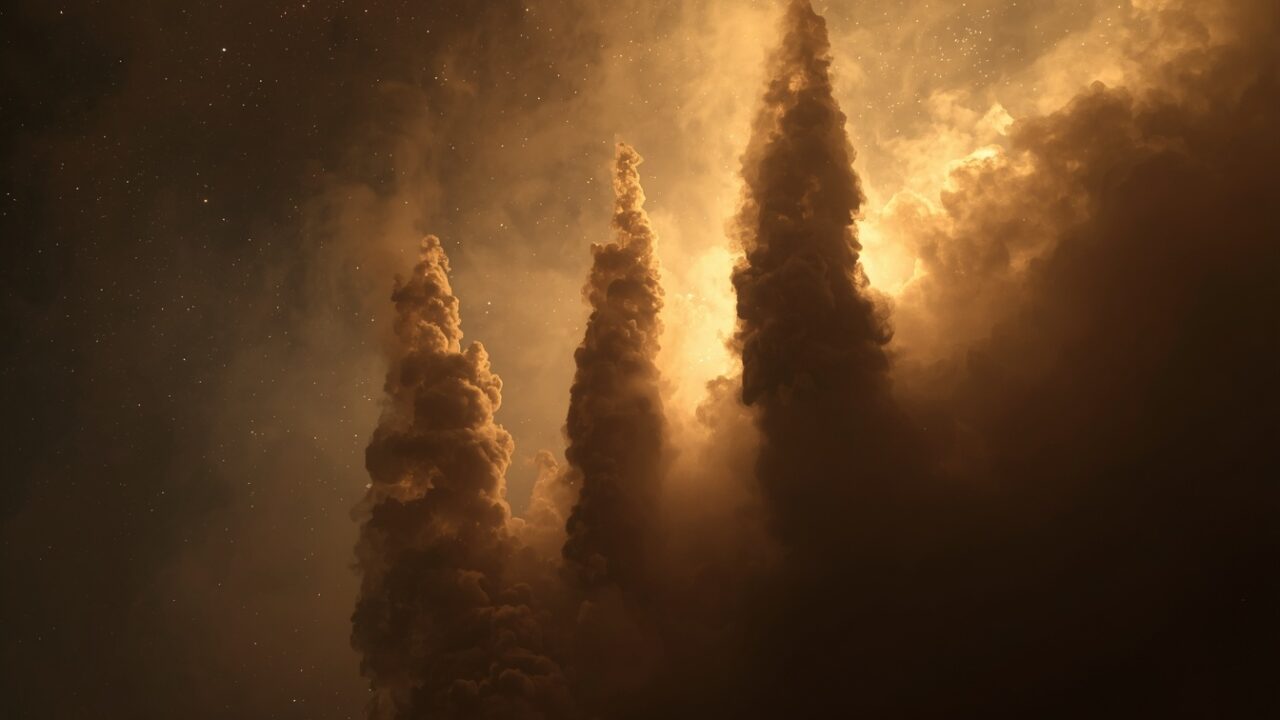
8 Incredible Hubble Eagle Nebula Photos:
Long before James Webb captured its infrared version, Hubble Eagle Nebula photos had already made astronomical history. The most famous of these, taken in 1995, introduced the world to the “Pillars of Creation” — a phrase that has since become shorthand for dramatic, awe-inspiring space photography.
The Original 1995 Photograph
The first widely celebrated Hubble Eagle Nebula photos showed three towering columns of gas and dust rising from the nebula’s interior, backlit by radiation from surrounding young stars. Captured using Hubble’s Wide Field and Planetary Camera 2, the image combined several filtered exposures to highlight different gas compositions in false color.
Understanding the Eagle Nebula’s Structure
The Eagle Nebula, also cataloged as Messier 16, is a massive star-forming region roughly 7,000 light-years from Earth. These photos reveal a nebula filled with dense gas columns, embedded young stars, and an open star cluster at its center that provides the intense ultraviolet radiation shaping the surrounding structures.
The 2014 Anniversary Update
To mark Hubble’s 25th anniversary, astronomers released an updated, higher-resolution version of the Pillars of Creation using Hubble’s newer Wide Field Camera 3. This version offered a wider field of view and sharper detail compared to the original, allowing for more precise comparisons of the pillars’ structure over nearly two decades.
Evidence of Ongoing Erosion
By comparing the 1995 and 2014 Hubble Eagle Nebula photos, astronomers detected subtle changes in the pillar structures, consistent with ongoing erosion caused by radiation and stellar winds from nearby massive stars. This comparison provided rare direct visual evidence of astronomical processes occurring on human-observable timescales.
The Role of Evaporating Gaseous Globules
Within the pillars, these photos revealed small, finger-like protrusions known as “EGGs” — Evaporating Gaseous Globules. These dense knots of gas are believed to be sites of ongoing star formation, gradually being exposed as surrounding material erodes away.
Wide-Field Views of the Nebula
Beyond the famous pillars, Hubble also captured broader Hubble Eagle Nebula photos showing the nebula’s full extent, including additional dust formations and the embedded star cluster NGC 6611, which powers much of the region’s illumination and erosion processes.
Comparing Hubble and Webb Versions
While James Webb’s infrared version revealed stars hidden within the dust, the original Hubble Eagle Nebula photos remain scientifically valuable for their visible-light perspective, showing how the nebula appears in wavelengths closer to human vision, useful for studying surface dust density and structure.
Cultural Impact of the Images
Few space photographs have achieved the same level of cultural recognition as the photos. The image has appeared in textbooks, documentaries, album covers, and countless design projects, cementing its place as one of the most recognizable astronomical images ever taken.
Where the Eagle Nebula Is and How to Find It
The Eagle Nebula, also cataloged as Messier 16, lies roughly 6,500 to 7,000 light-years away in the constellation Serpens. It sits in a rich part of the Milky Way near the border with Sagittarius, a region packed with nebulae and star clusters. From the Northern Hemisphere it is best seen in summer, low in the southern sky.
Through binoculars or a small telescope, you will mainly see the young star cluster NGC 6611 and a faint glow around it. The famous pillars are much harder to spot visually. Long-exposure photography, especially with narrowband filters, is usually needed to bring them out the way Hubble Eagle Nebula photos show them.
The Star Cluster Sculpting the Clouds
The pillars exist because of the hot, massive stars in NGC 6611. These stars pour out intense ultraviolet radiation and strong stellar winds that gradually erode the surrounding gas. Denser pockets of material resist the erosion longer, leaving the tall columns standing like rock formations shaped by wind in a desert.
This process is called photoevaporation. It both destroys and creates. It strips away the gas that could form new stars, yet it can also compress denser regions and trigger their collapse. The Eagle Nebula is therefore a place where one generation of stars is actively shaping the birth of the next.
The Myth That the Pillars Are Already Gone
A popular claim online says the Pillars of Creation were destroyed thousands of years ago by a supernova and we are only seeing old light. The idea came from Spitzer Space Telescope data around 2007 that showed hot dust which some researchers suggested might come from a supernova shock wave.
Later studies did not confirm that interpretation, and many astronomers now think the pillars are still standing, though slowly evaporating. They are expected to last for a long time on human scales, likely hundreds of thousands of years. It is a good example of how a tentative idea can spread widely before the science is settled.
Processing Hubble Data Yourself
Hubble’s data on the Eagle Nebula is public, and amateur image processors regularly create their own versions from the original files in the Mikulski Archive for Space Telescopes. The famous look comes from assigning colors to narrowband filters that isolate light from specific elements, such as hydrogen, oxygen and sulfur.
The classic mapping sends sulfur to red, hydrogen to green and oxygen to blue, often called the Hubble palette. Many astrophotographers use the same palette on their own images of the Eagle Nebula taken with backyard telescopes, which is why so many amateur photos of this object look similar to the professional ones.
How the Pillars Compare to Other Star Nurseries
The Eagle Nebula is not the only place with pillars of gas. Similar structures appear in the Carina Nebula, the Rosette Nebula and many other star-forming regions. Wherever massive young stars sit near dense clouds, their radiation carves the material into columns, ridges and cliffs.
What makes the Eagle’s pillars special is a combination of their clean shapes, their placement against a bright background and the timing of Hubble’s 1995 image. They became the first widely seen example of this process, and they remain the reference point that other pillar images are compared against.
For astronomers, studying many such regions together is more useful than any single image. Comparing pillars of different sizes and ages helps them understand how quickly clouds erode and how often that erosion triggers new stars.
A Note on the Name
The nebula gets its name from its overall outline, which some early observers thought resembled an eagle with outstretched wings. The pillars sit near the center of that shape, which is why they are often described as the eagle’s talons in older astronomy books.
Final Thoughts
Hubble Eagle Nebula photos laid the visual foundation for decades of public interest in space imagery, and their scientific value continues even as newer infrared observations add fresh layers of understanding to this iconic stellar nursery.
Keep exploring with our guides to Pillars of Creation photo science explained, James Webb Pillars of Creation image, James Webb star formation images and Rosette Nebula visual explainer. For official information, visit NASA’s Hubble Space Telescope page.
Frequently Asked Questions
When was the original Pillars of Creation photo taken?
Hubble captured the iconic image in 1995 using its Wide Field and Planetary Camera
2. What are EGGs in the Eagle Nebula?
Evaporating Gaseous Globules — dense gas knots believed to be active star-formation sites.
Was there an updated version of the photo?
Yes, a higher-resolution version was released in 2014 for Hubble’s 25th anniversary.
How far away is the Eagle Nebula?
It lies approximately 7,000 light-years from Earth.
Do the Hubble and Webb images show the same thing?
Both show the same pillars, but Webb’s infrared version reveals stars hidden by dust that Hubble’s visible-light photo could not capture.