Ultimate Exoplanet WASP-12b Visual Guide: 6 Amazing Facts

Ultimate Exoplanet WASP-12b Visual Guide:
Among the most extreme exoplanets studied in detail, WASP-12b presents a genuinely dramatic case study in planetary destruction. This Exoplanet WASP-12b visual guide breaks down what makes this scorching, doomed gas giant such a scientifically fascinating research subject.
An Extremely Close, Scorching Orbit
This Exoplanet WASP-12b visual guide highlights the planet’s extraordinarily close orbit, completing a full revolution around its host star in just over one Earth day, resulting in surface temperatures exceeding 2,500 degrees Celsius due to this extreme proximity.
A Football-Shaped Planet
Rather than a typical spherical shape, intense gravitational tidal forces from its host star have stretched the planet into a distinctly football-like shape, an unusual characteristic directly observable through detailed brightness curve analysis.
Slowly Being Consumed by Its Star
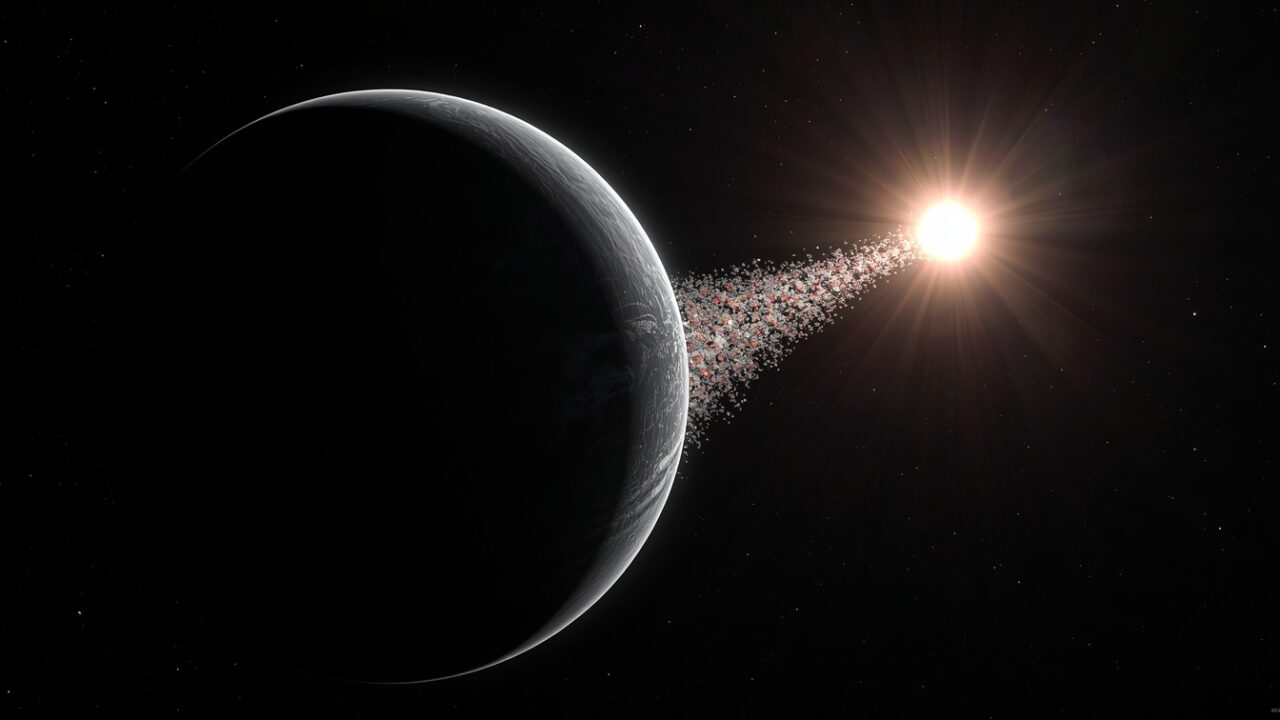
Perhaps most dramatically, this Exoplanet WASP-12b visual guide describes ongoing observations confirming the planet is gradually losing material to its host star, with astronomers estimating it may be completely consumed within the next several million years.
The Discovery of Carbon-Rich Composition
Detailed atmospheric analysis contributing to this Exoplanet WASP-12b visual guide suggested an unusually carbon-rich atmospheric composition, differing notably from typical gas giants, offering valuable comparative data for understanding exoplanet atmospheric diversity.
A Dark, Light-Absorbing Atmosphere
This Exoplanet WASP-12b visual guide also notes the planet’s atmosphere reflects remarkably little light, appearing almost perfectly black in certain wavelength observations, an unusual characteristic among studied hot Jupiter-type exoplanets.
How Astronomers Study Such Extreme Worlds
Given its extreme characteristics, WASP-12b has become a valuable target for testing exoplanet atmospheric study techniques, including secondary eclipse observations that reveal detailed thermal and compositional data.
Comparing to Other “Hot Jupiter” Exoplanets
The places the planet within the broader “hot Jupiter” category, gas giants orbiting extremely close to their host stars, though WASP-12b represents an especially extreme example even within this already dramatic exoplanet classification.
Artist Illustrations Versus Actual Imagery
Since direct surface imaging remains impossible at such extreme distances, circulating visual representations are artist illustrations based on atmospheric and orbital data rather than genuine photographs.
Discovered in 2008
WASP-12b was discovered in 2008 by the Wide Angle Search for Planets, or WASP, a UK-led survey that uses small robotic cameras to monitor large areas of sky. It orbits a star about 1,400 light-years away in the constellation Auriga.
The planet completes an orbit in just over one Earth day, which is why the always highlights its extreme closeness to its star.
An Orbit That Is Shrinking
In 2020, astronomers confirmed that WASP-12b’s orbit is slowly decaying. Its orbital period is shrinking by about 29 milliseconds per year.
At this rate, the planet could spiral into its star within a few million years.

Temperature Over 2,500 Kelvin
WASP-12b’s dayside temperature exceeds 2,500 Kelvin, hot enough to vaporize many metals. It is one of the hottest known planets.
Its extreme heat causes its atmosphere to expand.
Reflecting Almost No Light
Hubble observations suggested WASP-12b reflects very little light, making it darker than fresh asphalt. Its atmosphere absorbs most incoming light.
This dark appearance is linked to its high temperature.
A Tail of Escaping Gas
The planet is losing material to its star, possibly forming a stream or disk of gas. Observations suggest material is being stripped away.
This process shows how stars can consume planets.
Tidal Distortion
WASP-12b’s star stretches it into an egg shape. The planet’s gravity is overwhelmed by tidal forces.
It is an extreme example of star-planet interaction.
Studying WASP-12b’s Atmosphere
Scientists have used Hubble and other telescopes to study WASP-12b’s atmosphere. Early studies suggested it might be carbon-rich, though later work debated this. Its extreme temperature means molecules break apart on its dayside, complicating analysis.
A planet guide should mention that studying such extreme atmospheres helps scientists understand how planets behave under intense heat.
Tidal Forces Explained
Tidal forces arise because gravity weakens with distance. The side of WASP-12b facing its star feels stronger gravity than the far side, stretching the planet. Over time, tidal interactions transfer energy, causing the orbit to shrink.
The Host Star
WASP-12 is a yellow star slightly hotter and larger than the Sun. Its intense radiation heats WASP-12b to extreme temperatures.
Why This Planet Matters
WASP-12b provides a real example of a planet being destroyed by its star. Watching this process helps scientists understand the fate of close-in planets in other systems.
Where to See the Star
WASP-12 lies in Auriga, a winter constellation. The star is too faint for the naked eye, but amateur astronomers with sensitive cameras have even detected the planet’s transit dips themselves.
Hot Jupiters in General
WASP-12b belongs to a class called hot Jupiters, gas giants that orbit very close to their stars. The first hot Jupiter, 51 Pegasi b, was discovered in 1995.
A planet guide shows how extreme these planets can be, with temperatures and orbits unlike anything in our solar system.
How Hot Jupiters Got There
Scientists think hot Jupiters formed farther out and migrated inward, either through interactions with the disk of gas around young stars or gravitational encounters with other planets.
Their existence challenged early theories of planet formation, which were based only on our solar system.
Measuring Orbital Decay
Detecting WASP-12b’s shrinking orbit required years of precise transit timing. Observations from ground-based telescopes and TESS confirmed the decay.
It was the first time astronomers measured a planet spiraling into its star.
WASP-12b’s Legacy
WASP-12b has become a benchmark for studying extreme star-planet interactions. It shows how stars can gradually destroy their planets.
A planet guide highlights its role in testing theories of tidal forces and orbital decay.
Future Observations
Continued observations will track WASP-12b’s orbital decay and refine estimates of how long it will survive.
Final Thoughts
This planet guide demonstrates how studying extreme, doomed exoplanets like this scorching gas giant provides valuable insight into planetary destruction processes and atmospheric extremes not observable anywhere within our own solar system.
Key Takeaway
WASP-12b is a planet on borrowed time. Its scorching temperature, stretched shape and shrinking orbit make it one of the clearest examples of a star slowly destroying its own planet, and astronomers are watching the process unfold year by year.
Further Reading
Research papers from 2020 onward describe WASP-12b’s decaying orbit in detail and are freely available through the NASA ADS database.
Keep exploring with our guides to Exoplanet 55 Cancri e visual guide, James Webb exoplanet atmosphere images and Exoplanet Kepler-452b visual guide. For official information, visit NASA’s exoplanet science hub.
Frequently Asked Questions
Why is WASP-12b’s orbit so extreme?
It completes a full revolution in just over one Earth day, resulting in scorching surface temperatures.
Why is the planet football-shaped?
Intense gravitational tidal forces from its host star have stretched its shape.
Is this planet actually being destroyed?
Yes, observations confirm it’s gradually losing material to its host star.
What’s unusual about its atmosphere?
It’s unusually carbon-rich and reflects remarkably little light, appearing nearly black.
Are images of WASP-12b real photographs?
No, all circulating visuals are artist illustrations based on atmospheric and orbital data.