James Webb Cartwheel Galaxy Image: 7 Fascinating Facts

The James Webb Cartwheel Galaxy Image:
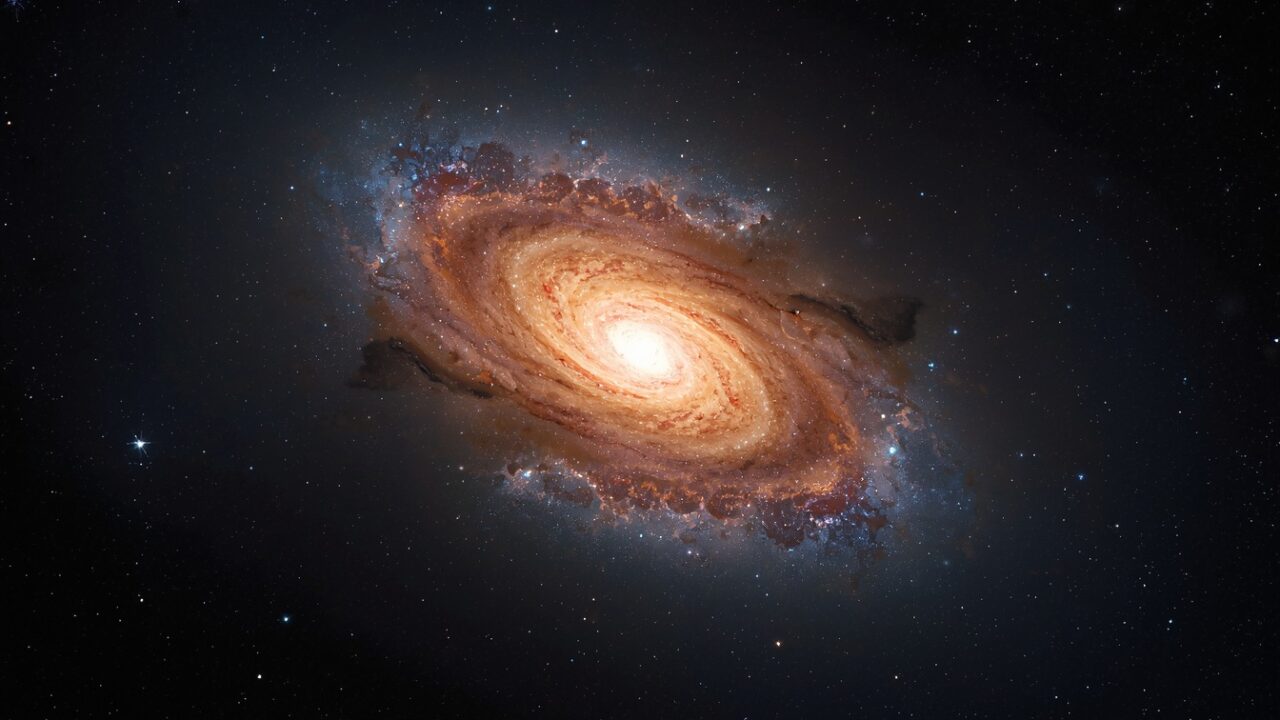
Released in August 2022, the James Webb Cartwheel Galaxy image gave astronomers their clearest view yet of one of the most unusual galaxy shapes in the observable universe. Located about 500 million light-years away in the constellation Sculptor, the Cartwheel Galaxy earned its name from its distinctive wheel-like structure, complete with a bright inner hub and an outer ring connected by spoke-like structures.
How the Cartwheel Shape Formed
The James Webb Cartwheel Galaxy image helped confirm long-standing theories about the galaxy’s violent origin. Astronomers believe a smaller galaxy collided directly through the center of a once-normal spiral galaxy, triggering ripples of star formation that expanded outward like a stone dropped into water, forming the two distinct rings visible today.
The Inner Ring: A Star-Formation Hotspot
Webb’s infrared instruments revealed intense star-forming activity concentrated in the galaxy’s inner ring. The James Webb Cartwheel Galaxy image showed this region glowing brightly, packed with young, hot stars that formed rapidly following the initial collision event.
The Outer Ring’s Expansion
The outer ring, still expanding outward from the collision point, showed clear evidence of ongoing star formation along its edge in the Webb data. This ring acts almost like a shockwave frontier, triggering new star birth as it plows through surrounding gas and dust.
Spoke-Like Structures Revealed
One of the most striking details in the image is the presence of faint spoke-like structures connecting the inner and outer rings. These features, only partially visible in earlier Hubble images, became far more defined thanks to Webb’s infrared sensitivity to dust and gas structures.
Webb’s Dual-Instrument Approach
Astronomers combined data from both NIRCam and MIRI to build a complete picture of the Cartwheel Galaxy. NIRCam captured younger, hotter stars, while MIRI revealed dust-rich regions and older stellar populations, together producing one of the most detailed James Webb Cartwheel Galaxy image composites released to date.
Comparing to Previous Hubble Observations
Older Hubble images had already identified the galaxy’s unusual ring shape, but lacked the resolution and infrared sensitivity to reveal fine structural details. The image significantly improved on this, offering sharper views of star clusters and dust lanes throughout the structure.
What This Teaches Us About Galaxy Collisions
Ring galaxies like the Cartwheel are relatively rare, making this a valuable natural laboratory for studying how galactic collisions trigger star formation and reshape galactic structure over time. The findings help refine broader models of how galaxies evolve following major gravitational interactions.
A Companion Galaxy Nearby
The Webb image also captured two smaller companion galaxies near the Cartwheel, believed to be related to the original collision event. Studying their positions and characteristics helps astronomers reconstruct the timeline of the collision that created the ring structure in the first place.
Where the Cartwheel Galaxy Is Located
The Cartwheel Galaxy lies about 500 million light-years away in the constellation Sculptor, in the southern sky. It was discovered in 1941 by astronomer Fritz Zwicky, and for decades it has been a textbook example of a ring galaxy. It is too faint to see well in small telescopes, so most people know it through space telescope images.
Its distance means the light captured in the left the galaxy long before complex life appeared on Earth. That light shows the galaxy as it was at a specific moment in its slow recovery from a collision, a moment Webb caught in exceptional detail.
Hot Dust and Hydrocarbons
Webb’s mid-infrared observations highlight regions rich in hydrocarbons and other organic molecules, along with silicate dust similar to the dust found on Earth. These features show up in orange and red tones in the combined image. They trace where gas and dust are concentrated, which is usually where new stars are forming.
The near-infrared data, by contrast, shows individual stars and young star clusters, appearing as bright blue dots. Seeing these layers together helps astronomers understand where the collision has triggered star birth and where the galaxy’s older stellar population remains.
A Galaxy Still in Transition
One of the most interesting conclusions from the Webb data is that the Cartwheel is not in a stable state. Its shape is still changing as the shock wave from the collision spreads outward. Over time, astronomers expect the galaxy to slowly reorganize, possibly returning toward a more typical spiral structure.
This makes the image a snapshot of a process that plays out over hundreds of millions of years. By comparing the Cartwheel with other ring galaxies at different stages, researchers can build a timeline of what happens after a galaxy is punched through by a smaller neighbor.
How the Colors Were Assigned
The released images combine data from NIRCam and MIRI, and like all Webb images they use representative color. Infrared light is invisible to the human eye, so image processors assign visible colors to different filters, typically giving shorter wavelengths bluer tones and longer wavelengths redder ones.
Knowing this helps you read the picture correctly. Blue does not mean the region is cold or water-rich, and red does not mean it is hot in the everyday sense. The colors simply indicate which wavelengths dominate, and scientists rely on the underlying data rather than the colors when drawing conclusions.
Other Ring Galaxies Worth Knowing
Ring galaxies are rare, making up only a small fraction of known galaxies. Besides the Cartwheel, well-known examples include Hoag’s Object in the constellation Serpens, which has a nearly perfect ring around a yellow core, and Arp 147, a pair of interacting galaxies where one has become a blue ring.
Not all rings form the same way. Collisional rings like the Cartwheel’s form when a smaller galaxy passes through a larger one’s center. Hoag’s Object may have a different origin, possibly involving gas captured from another galaxy. Studying these differences helps astronomers understand the many ways galaxies interact.
The Cartwheel remains the best-studied collisional example, partly because of its size and brightness, and Webb’s images have made it an even more valuable reference for future research.
How Big the Cartwheel Really Is
The Cartwheel’s outer ring spans roughly 150,000 light-years, making the galaxy somewhat larger than the Milky Way. The ring is expanding outward at high speed, and it has already swept up enough gas to trigger star formation across a region larger than our entire galaxy’s disk.
Final Thoughts
The image stands as one of the clearest demonstrations of how galactic collisions can dramatically reshape a galaxy’s structure, offering a rare, detailed snapshot of cosmic violence frozen in the act of triggering new star birth.
Keep exploring with our guides to James Webb Southern Ring Nebula, Galaxy collision images explained and James Webb Tarantula Nebula image. For official information, visit NASA’s James Webb Space Telescope page.
Frequently Asked Questions
What is the Cartwheel Galaxy?
A ring-shaped galaxy located about 500 million light-years away, formed by a galactic collision.
How did the ring shape form?
A smaller galaxy passed directly through a spiral galaxy’s center, triggering expanding rings of star formation.
What did Webb’s image reveal that Hubble couldn’t?
Finer spoke-like structures and detailed star-forming regions became visible thanks to Webb’s infrared capabilities.
Are there other galaxies near the Cartwheel?
Yes, two smaller companion galaxies appear nearby, likely linked to the original collision.
Why are ring galaxies scientifically important?
They help astronomers study how collisions reshape galaxies and trigger new star formation.

1 comment