Exciting Artemis II Flight Update: NASA Successfully Completes Orbit Adjustment Before Next Critical 2026 Burn

Exciting Artemis II Flight Update: NASA Successfully Completes Orbit Adjustment Before Next Critical 2026 Burn
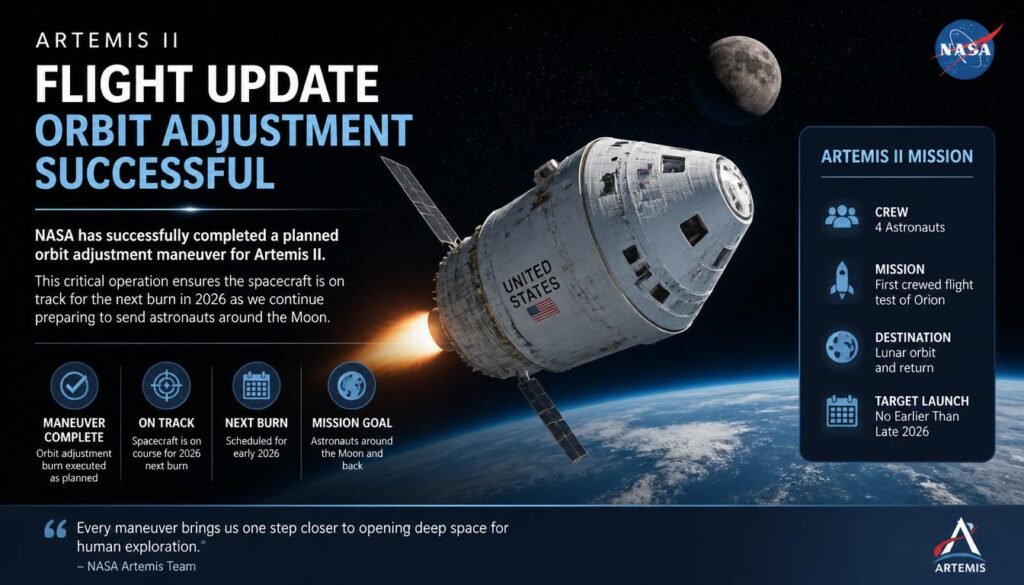
NASA’s Artemis II mission has reached another important milestone in its journey beyond Earth orbit. After a successful launch and early flight operations, mission controllers confirmed the completion of the perigee raise maneuver, a key orbital adjustment that prepares the spacecraft for its next phase of deep-space testing.
This update also includes a brief communications interruption that was quickly resolved, along with preparations for an upcoming NASA press conference and the next orbital burn.
What Happened: Perigee Raise Maneuver Successfully Completed
The perigee raise maneuver was executed as planned by the upper stage of the launch system.
Interim Cryogenic Propulsion Stage ignited its RL10 engine for a precise orbital burn that increased the lowest point of the spacecraft’s orbit around Earth.
\text{Perigee Raise Burn} \rightarrow \Delta v \text{ increases orbital perigee altitude}
This maneuver is essential because it:
- Improves orbital stability
- Reduces atmospheric drag
- Prepares the spacecraft for deep-space checkout
- Positions Orion for further orbital adjustments
By raising the perigee, engineers ensure that the spacecraft remains in a more controlled and stable Earth orbit before heading toward lunar operations.
How the Burn Worked
The RL10 engine fired at a carefully calculated time and duration. This burn:
- Increased the lowest point of the orbit (perigee)
- Fine-tuned orbital shape
- Balanced spacecraft trajectory for future maneuvers
Even small errors in this stage could affect later mission phases, so the burn is executed with extreme precision.
Temporary Communications Drop: What Happened?
Shortly after the maneuver, mission controllers experienced a temporary loss of communications with the spacecraft.
During this period:
- Ground systems could not receive data
- Spacecraft systems continued operating normally
- Astronauts confirmed they could still hear ground communications
The issue was resolved quickly, and NASA teams are now investigating the cause of the signal interruption.
This type of event is not unusual in early mission phases, especially during orbital transitions where spacecraft orientation and antenna alignment can temporarily affect signal strength.
NASA Confirms Crew Safety and System Stability
Despite the brief communication gap, all mission systems remain healthy.
The crew aboard the Orion spacecraft reported no loss of internal communication or operational issues.
Key confirmations include:
- Life support systems functioning normally
- Flight computers stable
- Navigation systems operating correctly
- Continuous crew-ground voice link maintained
This reassures mission teams that Artemis II remains on a safe trajectory.
Upcoming Milestone: Apogee Raise Burn
The next major step in the mission is the apogee raise burn, which will increase the highest point of Orion’s orbit.
This maneuver will:
- Expand the spacecraft’s orbital path
- Prepare Orion for high Earth orbit operations
- Support a 23.5-hour systems checkout phase
Once completed, the spacecraft will be in an ideal orbit for extended testing before moving toward lunar trajectory planning.
Why Orbital Raises Are Important
Orbital adjustment burns like perigee and apogee raises are critical for deep-space missions because they:
- Ensure stable spacecraft trajectories
- Allow system testing in controlled environments
- Reduce fuel consumption for later maneuvers
- Improve mission safety margins
These steps simulate conditions similar to lunar travel while still remaining in Earth orbit.
NASA’s Mission Control Response and Press Conference
Following the maneuver and communication review, NASA scheduled a postlaunch press conference.
Press Conference Participants:
- Jared Isaacman
- Amit Kshatriya
- Lori Glaze
- Norm Knight
The briefing will cover:
- Details of the orbital burn
- Communications interruption analysis
- Spacecraft health updates
- Next mission milestones
Artemis II Mission Status: Where Things Stand
At this stage, Artemis II is progressing as expected:
- Launch completed successfully
- Orbit adjustments underway
- Spacecraft systems stable
- Crew safe and fully operational
The mission is now transitioning from ascent phase to orbital testing phase.
What Happens Next in the Mission
After the apogee raise burn, the mission will enter a key operational phase:
1. High Earth Orbit Checkout
A 23.5-hour systems test period where engineers evaluate:
- Navigation systems
- Power generation
- Thermal stability
- Communication performance
2. Deep Space Simulation
Spacecraft systems are tested under conditions similar to lunar distance operations.
3. Preparation for Lunar Trajectory
Final adjustments will prepare Orion for its path around the Moon.
Importance of Artemis II for Future Exploration
Artemis II is not just a test flight—it is a foundation for future missions, including:
- Lunar surface exploration missions
- Gateway space station operations
- Human Mars mission planning
It helps NASA validate systems that will support long-duration human spaceflight beyond Earth.
Frequently Asked Questions (FAQs)
What is the perigee raise maneuver?
It is an orbital burn that increases the lowest point of the spacecraft’s orbit around Earth.
Why was a communication loss reported?
A temporary signal interruption occurred after the burn, likely due to spacecraft orientation changes. It was quickly resolved.
Is the crew safe after the communication issue?
Yes, NASA confirmed all crew systems and communications are functioning normally.
What is the next major mission step?
The next step is the apogee raise burn, which increases the highest orbital point.
What engine performed the burn?
The RL10 engine on the Interim Cryogenic Propulsion Stage performed the maneuver.
What is the purpose of orbital adjustments?
They prepare the spacecraft for deep-space operations and ensure stable orbit conditions.
How long will Orion stay in Earth orbit?
Approximately 23.5 hours after final orbital adjustments before transitioning to further mission phases.
What spacecraft is being used?
NASA’s Orion spacecraft is being used for the Artemis II mission.
Conclusion
The successful completion of the perigee raise maneuver marks another critical step in the Artemis II mission. Despite a brief communications anomaly, the spacecraft remains fully operational and on track.
With the upcoming apogee raise burn and system checkout phase, NASA continues moving closer to a new era of human deep-space exploration—bringing astronauts one step nearer to the Moon and future missions to Mars.
read another articles
Keep exploring