Exciting NASA Artemis II Launch Day: Historic Moon Blastoff and Live 2026 Mission Updates

Exciting NASA Artemis II Launch Day: Historic Moon Blastoff and Live 2026 Mission Updates
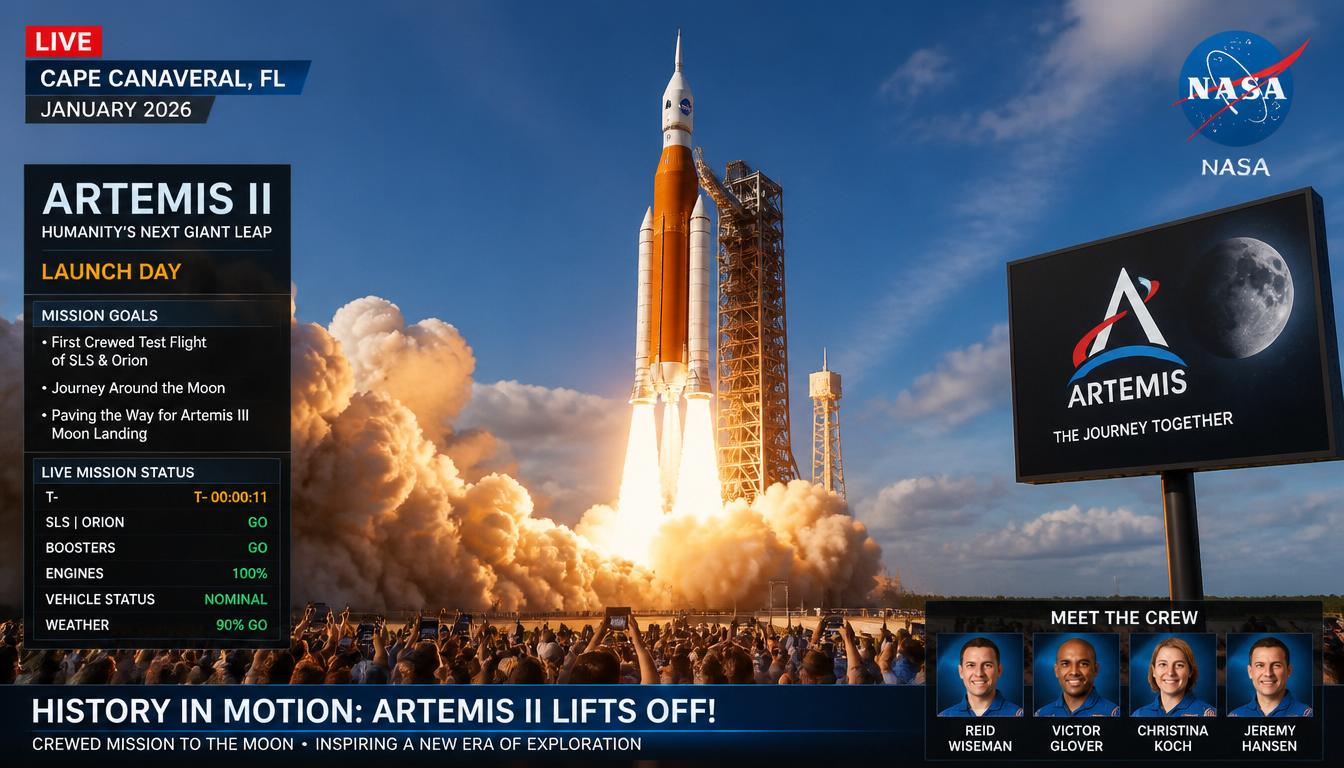
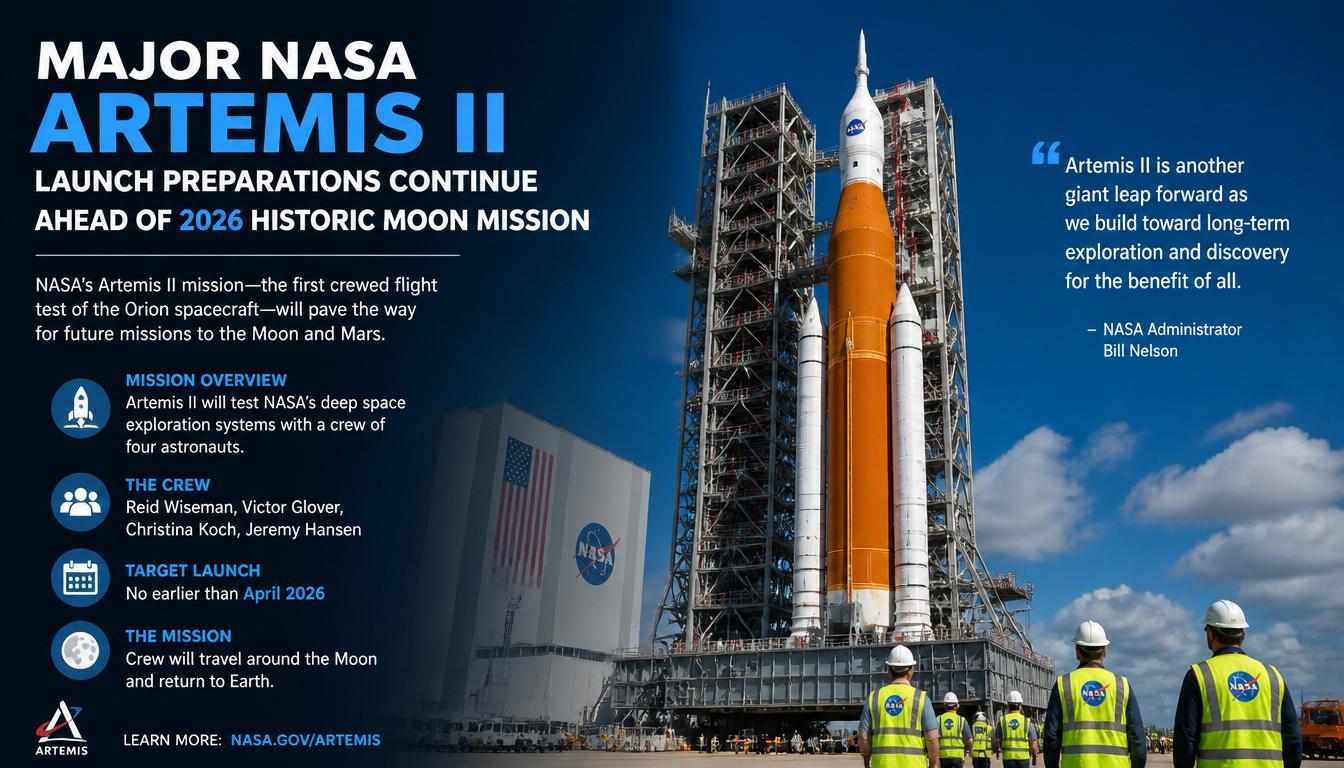
NASA’s Artemis II mission has officially lifted off from Launch Complex 39B at Kennedy Space Center in Florida, marking a historic step in humanity’s return to deep space exploration. At 6:35 p.m. EDT on April 1, 2026, the Space Launch System (SLS) rocket and Orion spacecraft began their journey carrying four astronauts around the Moon.
This launch is not just a single event—it is a carefully choreographed sequence of thousands of engineering actions, each designed to ensure safety, precision, and mission success.
Historic Liftoff Marks the Beginning of Artemis II
At exactly 6:35 p.m. EDT, the SLS rocket ignited its engines and lifted off from the pad, generating massive thrust that overcame Earth’s gravity.
Space Launch System and the Orion spacecraft carried the crew into space, marking the first crewed lunar mission in NASA’s Artemis program.
The crew includes:
- Reid Wiseman — Commander
- Victor Glover — Pilot
- Christina Koch — Mission Specialist
- NASA Artemis II Launch Day: Historic Blastoff and Real-Time Mission Progress Updates
This mission is expected to last approximately 10 days and will take the crew farther from Earth than any human mission in more than 50 years.
NASA Artemis II Launch Day: Historic Blastoff and Real-Time Mission Progress Updates
At liftoff, the rocket produced an incredible 8.8 million pounds of thrust.
This force came from:
- Four RS-25 core stage engines
- Two massive solid rocket boosters
The boosters provided more than 75% of the total thrust, helping lift the 5.75-million-pound vehicle off the launch pad.
As the rocket ascended, the ground systems disconnected automatically. These included:
- Electrical umbilicals
- Fuel lines
- Communication links
This ensured the rocket became fully independent for flight.
Early Flight: Key Ascent Milestones
The launch followed a precise sequence of events. Each milestone represents a critical stage of flight safety and performance.
Major Ascent Timeline:
- T+00:00:07 — Rocket clears launch tower and begins roll maneuver
- T+00:00:56 — Vehicle reaches supersonic speed
- T+00:01:12 — Maximum dynamic pressure (Max-Q)
- T+00:02:09 — Solid rocket booster separation
- T+00:03:13 — Launch abort system jettison
- T+00:08:02 — Main engine cutoff
- T+00:08:14 — Core stage separation
Each step ensures the spacecraft transitions safely from Earth launch to orbital flight.
Core Stage Separation: Transition to Space Operations
Once main engine cutoff occurred, the core stage detached from the upper stage and Orion spacecraft.
This moment marked the end of the most powerful phase of ascent.
The spacecraft then entered a quieter but more complex phase of flight, where orbital maneuvers and system activations begin.
Solar Panels Unfurl: Orion Activates Its Power in Space
Shortly after separation, Orion deployed its solar array wings.
y = 4,\text{solar array wings (SAWs)}
These solar arrays:
- Extend to about 63 feet
- Contain 15,000 solar cells per wing
- Provide continuous electrical power
- Track the Sun automatically
This ensures Orion can operate independently throughout its deep-space journey.
Why Solar Arrays Are Critical for Deep Space
Without solar arrays, Orion would not have enough energy to support:
- Life support systems
- Communication with Earth
- Navigation computers
- Cabin temperature control
These systems are essential for keeping astronauts safe during their 10-day mission.
Upper Stage Ignition and Orbital Maneuvers
After separation, the Interim Cryogenic Propulsion Stage (ICPS) ignited to push Orion into a stable orbit around Earth.
This phase includes two key maneuvers:
- Perigee Raise Maneuver (PRM)
- Apogee Raise Burn (ARB)
These burns shape the spacecraft’s orbit and prepare it for the journey to the Moon.
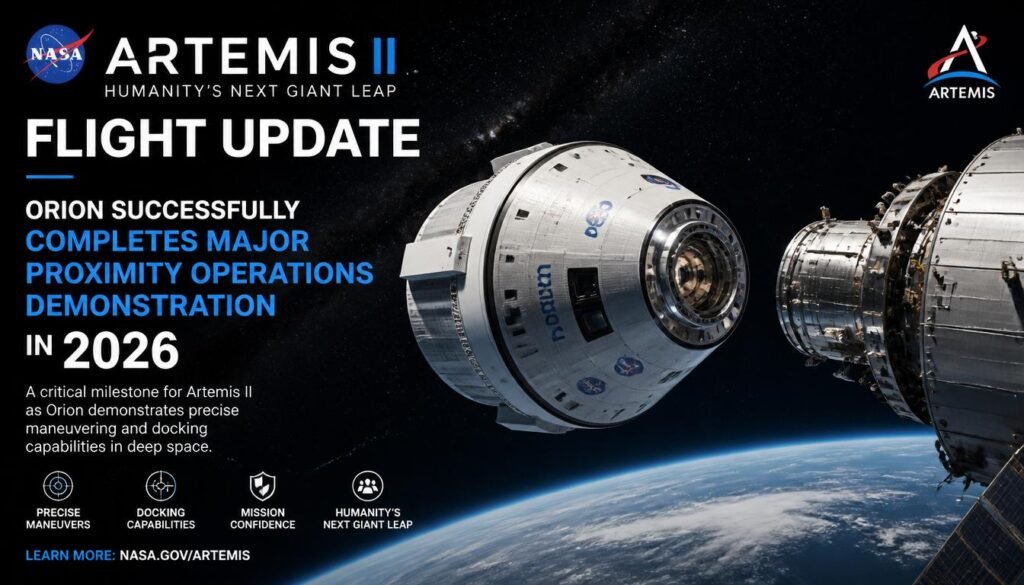
Proximity Operations: Training for Future Moon Missions
One of the most important objectives of Artemis II is testing manual spacecraft control.
Astronauts will perform proximity operations, which involve:
- Maneuvering Orion near another spacecraft stage
- Practicing docking-like movements
- Testing navigation systems
This is essential for future Artemis missions where spacecraft will dock with lunar landers.
Post-Launch Mission Updates and NASA Coverage
NASA provides continuous coverage of Artemis II through:
- NASA+ streaming platform
- YouTube live broadcasts
- Mission control updates from Houston
- Artemis blog real-time updates
A post-launch press conference is also scheduled to provide mission status and early flight analysis.
What makes Artemis II significant for the future of space exploration?
Artemis II is more than a test flight; it serves as a foundational mission for upcoming deep-space exploration.
It helps NASA prepare for:
- Lunar surface landings
- Long-duration space missions
- Mars exploration planning
- Advanced spacecraft docking systems
This mission proves that humans can safely travel beyond low Earth orbit again.
Scientific and Engineering Importance of the Mission
Artemis II will allow NASA to test:
- Life support in deep space
- Radiation exposure effects
- Communication delays and systems
- Navigation accuracy far from Earth
These experiments are critical before sending astronauts to the Moon’s surface again.
Future Goals of the Artemis Program
NASA’s long-term Artemis vision includes:
- Establishing a sustainable lunar presence
- Building lunar Gateway stations
- Preparing for Mars missions
- Expanding commercial space partnerships
Artemis II is one of the most important stepping stones in this plan.
Frequently Asked Questions (FAQs)
What is Artemis II?
Artemis II is NASA’s first crewed mission under the Artemis program, sending astronauts around the Moon.
When did Artemis II launch?
It launched at 6:35 p.m. EDT on April 1, 2026.
How many astronauts are on Artemis II?
There are four astronauts on the mission.
What rocket is used in Artemis II?
NASA uses the Space Launch System (SLS) rocket.
What spacecraft carries the crew?
The Orion spacecraft carries the astronauts.
Why are solar arrays important?
They supply all the electrical power required by the spacecraft while it is in deep space.
What is Max-Q?
Max-Q refers to the moment during ascent when the rocket endures the greatest amount of aerodynamic pressure.
What is the duration of the Artemis II mission?
The mission lasts approximately 10 days.
What happens after launch?
The spacecraft carries out orbital adjustments, system verifications, and makes its way toward a trajectory for a lunar flyby.
Conclusion
The launch of Artemis II marks a significant landmark in the history of space exploration. From liftoff to orbital operations, every phase of the mission demonstrates advanced engineering, precision coordination, and international collaboration.
This mission is not merely a flight—it marks the start of a new age of human exploration beyond Earth’s orbit, laying the groundwork for future lunar bases and, ultimately, journeys to Mars.
read another article
Keep exploring
1 comment