NASA Webb Telescope Micrometeoroid Protection Update: How Scientists Are Safeguarding the Future of Space Exploration in 2026

NASA Webb Telescope Micrometeoroid Protection Update: How Scientists Are Safeguarding the Future of Space Exploration in 2026
Introduction
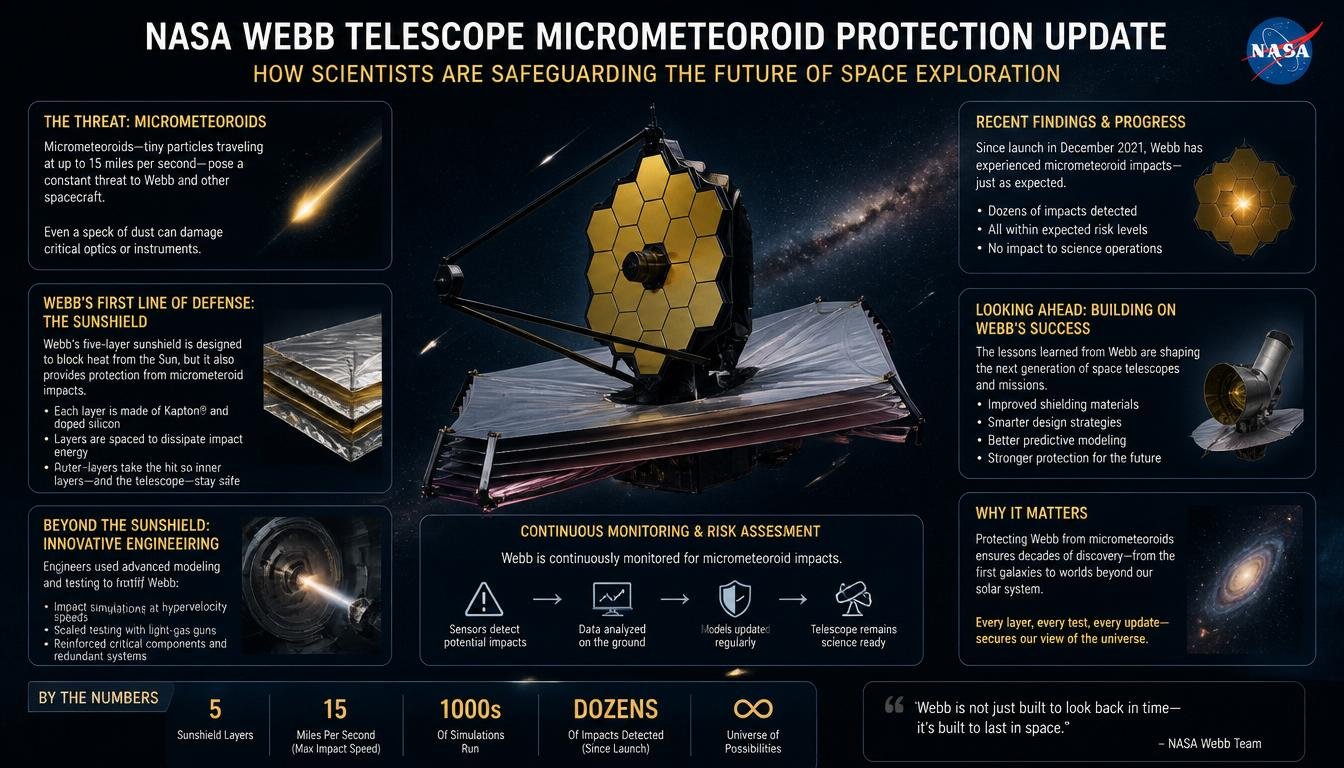
The NASA James Webb Space Telescope continues to deliver remarkable discoveries about the universe, but operating such a powerful observatory in deep space comes with serious challenges. One of the biggest threats facing the telescope is micrometeoroid impacts — tiny dust-sized particles traveling through space at extremely high speeds.
Recently, NASA released an important update regarding how the James Webb Space Telescope is handling these unavoidable impacts and what scientists are doing to protect the telescope’s delicate mirrors for many years to come.
Even though several micrometeoroid strikes have already hit Webb’s primary mirror, the telescope continues to perform beyond expectations. Scientists are now introducing new observation strategies to reduce future risks and preserve Webb’s extraordinary optical performance.
What Are Micrometeoroids?
Micrometeoroids are tiny rock or dust particles moving through space at remarkably high speeds. Although these particles are tiny, their speed gives them enough energy to damage spacecraft equipment.
In space, there is no atmosphere to slow these particles down. As a result, spacecraft such as the James Webb Space Telescope regularly encounter micrometeoroid impacts during missions.
These impacts are considered normal for long-term space operations. Engineers design spacecraft with protective systems and durable materials to withstand continuous exposure to this harsh environment.
Why Webb’s Mirrors Are So Important
The James Webb Space Telescope relies on a massive gold-coated primary mirror to collect faint infrared light from distant galaxies, stars, and planets.
The telescope’s primary mirror consists of 18 hexagonal mirror segments working together as one giant mirror. These mirrors are extremely sensitive because they must detect incredibly weak signals from billions of light-years away.
Even tiny imperfections caused by micrometeoroid strikes can affect how accurately the telescope focuses light. That is why NASA constantly monitors Webb’s mirror performance.
Despite these risks, Webb was carefully engineered to tolerate a certain level of damage while still maintaining excellent scientific capabilities.
Webb Has Experienced Multiple Impacts
According to NASA engineers, Webb has already experienced 14 measurable micrometeoroid impacts on its primary mirror since launch.
Most of these impacts caused only very small optical changes that scientists expected during mission planning. Engineers had already prepared for this possibility before Webb was launched into space.
Mike Menzel, Webb’s lead mission systems engineer, explained that all impacts except one remained well within expected safety limits. Even after the stronger-than-expected strike, the telescope’s optical performance still exceeds mission requirements.
This means Webb continues to function at a level even better than originally planned.
The Unexpected High-Energy Impact
One micrometeoroid strike in May caused more concern because it carried significantly more energy than scientists predicted in their prelaunch models.
The impact struck a particularly sensitive area of the telescope’s primary mirror, creating more optical distortion than previous impacts.
However, NASA experts stressed that the telescope remains fully operational and continues producing world-class science observations.
After detailed analysis, scientists concluded that this impact was a rare statistical event rather than a sign of ongoing danger.
NASA’s Expert Investigation Team
To better understand the situation, NASA assembled a specialized team of experts from several organizations.
The investigation included specialists from:
- NASA Goddard Space Flight Center
- Space Telescope Science Institute
- Webb mirror manufacturers
- NASA Marshall Space Flight Center
These experts studied the energy of the impact, the direction of the particle, and the location where it struck the mirror.
Their findings confirmed that Webb’s design remains highly effective and capable of handling the harsh conditions of space.
Understanding the “Micrometeoroid Avoidance Zone”
One of the most important outcomes of NASA’s investigation was the creation of a “micrometeoroid avoidance zone.”
Scientists discovered that particles striking Webb head-on are much more dangerous because of the telescope’s movement through space.
When a micrometeoroid approaches from the opposite direction of Webb’s orbit, the relative collision speed becomes much higher. This increases the particle’s kinetic energy dramatically.
According to NASA optical experts, head-on impacts can have:
- Twice the relative velocity
- Four times the kinetic energy
Because of this, NASA plans to reduce observations in these risky directions whenever possible.
How NASA Will Protect Webb in the Future
NASA will begin implementing new observation scheduling strategies during Webb’s second science cycle, known as Cycle 2.
The telescope will avoid pointing toward dangerous directions in space whenever alternative observation times are available.
This adjustment does not mean scientists will stop observing certain parts of the sky permanently. Instead, observations will simply be scheduled during safer periods when Webb occupies a different position in its orbit.
For highly important or time-sensitive targets — such as planets, asteroids, or other solar system objects — Webb may still observe within the avoidance zone if necessary.
This flexible strategy will help preserve Webb’s mirror quality for decades.
Why Webb’s Performance Is Still Extraordinary
Even after multiple micrometeoroid impacts, Webb’s optical system remains more powerful than required for its mission goals.
The telescope continues to provide:
- Extremely detailed infrared images
- Deep observations of distant galaxies
- Precise measurements of exoplanet atmospheres
- Advanced star formation studies
Scientists say Webb’s current performance is still roughly twice as good as the minimum required mission standards.
This highlights the incredible engineering behind the telescope and the careful planning involved in its construction.
The Importance of Long-Term Space Telescope Protection
Space telescopes are among the most expensive and scientifically valuable machines ever built. Protecting them from damage is essential for maximizing scientific discoveries.
The James Webb Space Telescope was designed to operate for many years while orbiting around the Sun approximately one million miles from Earth near the second Lagrange point (L2).
Because astronauts cannot easily repair Webb in deep space, NASA must rely on careful mission planning and engineering solutions to maintain the telescope’s health.
The new micrometeoroid avoidance strategy represents an important step toward extending Webb’s operational lifetime.
Webb’s Future Scientific Mission
Despite these challenges, Webb’s future remains extremely promising.
The telescope is expected to continue transforming astronomy through research involving:
- Early galaxies
- Black holes
- Exoplanets
- Stellar evolution
- Dark matter
- Cosmic origins
Every month, Webb provides new discoveries that expand human understanding of the universe.
NASA engineers remain confident that the telescope will continue producing groundbreaking science for many years to come.
Conclusion
The James Webb Space Telescope faces constant threats from micrometeoroids traveling through space at tremendous speeds. However, NASA’s latest update confirms that Webb remains in outstanding condition despite multiple impacts on its primary mirror.
Through expert analysis and improved observation strategies, scientists are actively working to minimize future risks and protect the telescope’s incredible optical performance.
The introduction of the micrometeoroid avoidance zone demonstrates how careful engineering and scientific planning can help extend the life of one of humanity’s greatest space observatories.
As Webb continues exploring the universe, it will undoubtedly unlock even more secrets about galaxies, stars, planets, and the origins of cosmic history.
FAQs
1. What are micrometeoroids?
Micrometeoroids are tiny dust or rock particles traveling through space at extremely high speeds.
2. How many impacts has Webb experienced?
NASA reported that Webb has experienced 14 measurable micrometeoroid impacts on its primary mirror.
3. Did the impacts damage the telescope?
Most impacts caused only minor optical changes. Webb still performs better than required mission standards.
4. What is the micrometeoroid avoidance zone?
It is a safer observation strategy that avoids pointing the telescope toward directions with higher impact risks.
5. Why are head-on impacts more dangerous?
Head-on impacts create greater collision speeds and much higher kinetic energy, increasing the chance of mirror damage.
6. Can Webb still observe dangerous regions of space?
Yes. Time-sensitive observations can still occur in the avoidance zone if necessary.
7. Why can’t astronauts repair Webb easily?
Webb operates far from Earth near the L2 point, making repair missions extremely difficult.
8. What is Webb mainly used for?
Webb studies distant galaxies, stars, exoplanets, black holes, and many other cosmic phenomena using infrared astronomy.
9. Is Webb still working properly?
Yes. NASA confirmed that Webb’s optical performance remains excellent even after the impacts.
10. How long is Webb expected to operate?
Scientists expect Webb to continue functioning and producing discoveries for many years or possibly decades.