6 Fascinating Titan Surface Images Saturn Moon Discoveries


Titan Surface Images Saturn Moon:
Saturn’s largest moon presents one of the most Earth-like yet fundamentally alien landscapes in the solar system, and Titan surface images Saturn moon collections reveal liquid methane lakes, towering dunes, and a thick, hazy atmosphere unlike any other moon.
Why Titan’s Surface Was Hidden for So Long
Before the Cassini-Huygens mission, Titan surface images Saturn moon photography remained impossible due to the moon’s thick, hazy atmosphere completely obscuring surface details from any visible-light observation, requiring specialized imaging techniques to finally reveal what lies beneath.
The Huygens Probe’s Historic Landing
In 2005, the Huygens probe achieved the remarkable feat of capturing actual surface-level Titan surface images Saturn moon photography during its descent and landing, providing humanity’s first direct look at this moon’s genuinely alien landscape.
Liquid Methane Lakes and Seas
Among the most remarkable discoveries, Titan surface images Saturn moon data revealed genuine liquid lakes and seas, though composed of liquid methane and ethane rather than water, making Titan the only other body in the solar system confirmed to have stable surface liquids.
Dune Fields Stretching Across the Surface
Radar-based Titan image mapping revealed extensive dune fields composed of hydrocarbon particles rather than silicate sand, stretching across large portions of the moon’s equatorial regions in patterns remarkably similar to Earth’s desert dune systems.
River Networks and Erosion Features
Detailed Titan image data show clear evidence of river channels and erosional features, suggesting an active liquid cycle involving methane rain, evaporation, and surface flow, analogous to Earth’s water cycle but involving entirely different chemistry.
Using Radar to See Through the Haze
Since visible light imaging remains largely blocked by Titan’s atmosphere, most detailed Titan image mapping relies on radar imaging techniques, capable of penetrating the thick haze to reveal genuine surface topography and liquid body locations.
Cryovolcanism: Ice Volcanoes
Some Titan image data suggest possible cryovolcanic activity, where volcanoes erupt water-ammonia mixtures rather than molten rock, though this phenomenon remains an active area of ongoing scientific investigation and debate.
Why Titan Fascinates Astrobiologists
Beyond its visual strangeness, Titan image research interests astrobiologists studying prebiotic chemistry, since the moon’s complex hydrocarbon chemistry offers valuable insight into chemical processes that might have preceded life’s origin on early Earth.
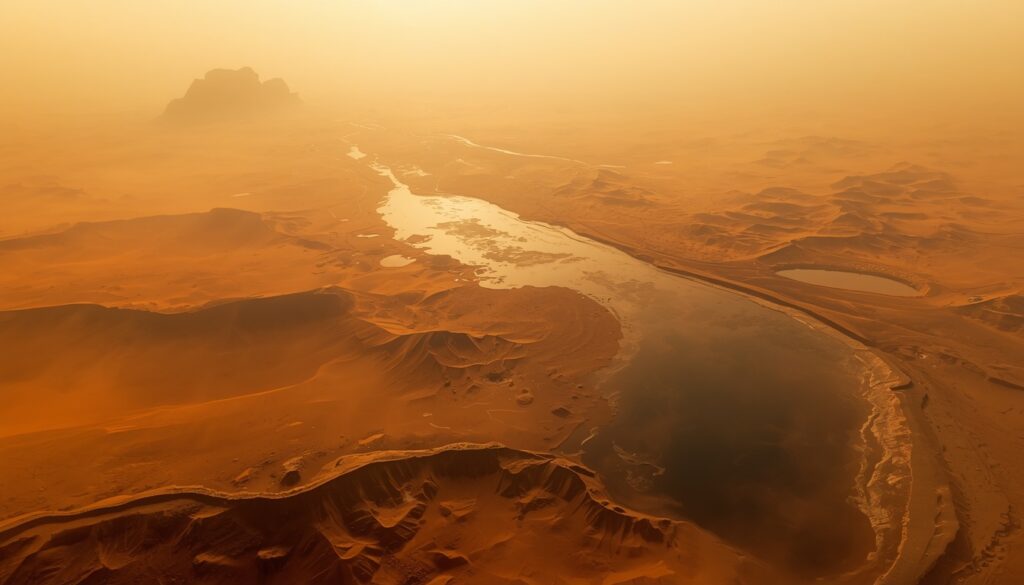
An Atmosphere Thicker Than Earth’s
Titan is the only moon in the solar system with a thick atmosphere. Its surface pressure is about 1.5 times that of Earth, and its atmosphere is mostly nitrogen, like ours, with a few percent methane.
The orange haze that hides the surface is made of complex organic molecules formed when sunlight breaks apart methane. Titan image researchers study are often taken at infrared wavelengths that can see through this haze.
Kraken Mare: Titan’s Largest Sea
Kraken Mare is Titan’s largest sea, covering an area larger than the Caspian Sea on Earth. It is filled with liquid methane and ethane.
Cassini’s radar measured the depth of some seas, finding places more than 100 meters deep.
Magic Islands
Cassini observed bright features appearing and disappearing in Ligeia Mare, nicknamed magic islands. They may be waves, bubbles or floating solids.
These changes suggest Titan’s seas are dynamic environments.
Weather on Titan
Titan has a weather cycle similar to Earth’s water cycle, but with methane instead of water. Methane evaporates, forms clouds and falls as rain.
Cassini observed rainstorms that darkened the surface and changed its appearance.
Huygens’ View From the Surface
The Huygens probe landed on January 14, 2005, and sent back images of rounded pebbles, likely made of water ice. The pebbles showed signs of erosion by flowing liquid.
Huygens operated on the surface for about 72 minutes before its batteries ran out.
Dragonfly’s Planned Exploration
NASA’s Dragonfly mission is a rotorcraft that will fly between locations on Titan. It is scheduled to launch in 2028 and arrive in the mid-2030s.
Dragonfly will study Titan’s chemistry and search for signs of prebiotic processes.
Titan as a Model of Early Earth
Titan’s organic-rich atmosphere and surface may resemble conditions on early Earth before life appeared. Studying it could reveal how complex chemistry develops.
This makes Titan one of the most interesting worlds in the solar system.
Titan’s Mysterious Surface Chemistry
Titan’s surface is coated with organic compounds that fall from the atmosphere like snow. Over time, these materials may mix with liquid water from impacts or cryovolcanoes, possibly creating conditions for more complex chemistry.
Scientists hope Dragonfly will reveal whether such chemistry has taken place and how far it has progressed.
Cassini’s Radar Mapping
Because Titan’s haze blocks visible light, Cassini used radar to map the surface during more than 120 flybys. The radar images revealed seas, lakes, river valleys, mountains and vast dune fields near the equator.
The dunes are made of organic grains rather than sand like Earth’s, but they are shaped by winds in similar ways. Titan image researchers use today are often radar mosaics stitched from these flybys, since they show landforms hidden from ordinary cameras.
A Hidden Ocean Beneath the Ice
Cassini’s gravity measurements showed that Titan flexes as it orbits Saturn, which suggests a global ocean of liquid water beneath its icy crust. That ocean may lie roughly 50 to 100 kilometers below the surface.
This means Titan has two very different liquid environments: methane seas on the surface and a water ocean deep below. Both are of interest to scientists studying the chemistry that could lead to life.
Seasons on Titan
A Titan year lasts about 29.5 Earth years, matching Saturn’s orbit. Cassini observed changes from northern winter to northern summer, including shifting clouds and changing lakes. These seasonal observations were only possible because the mission lasted so long.
How Scientists Picked Dragonfly’s Landing Area
Dragonfly will land near the Shangri-La dune fields and later fly toward Selk crater, an impact site where liquid water may once have mixed with organic material. Scientists chose this region because it combines varied terrain with a chance to study chemistry that could resemble early Earth. The rotorcraft will hop between sites, covering far more ground than a wheeled rover could manage on Titan’s surface.
Final Thoughts
Titan image photography reveals one of the solar system’s most genuinely alien yet strangely familiar landscapes, combining Earth-like geological processes with completely different underlying chemistry unique to this remarkable moon.
Keep exploring with our guides to Saturn Cassini grand finale photo story, Enceladus ice geysers images and Venus atmosphere images explained. For official information, visit NASA’s Artemis program page.
Frequently Asked Questions
Why was Titan’s surface hidden for so long?
Its thick, hazy atmosphere blocks visible light, requiring specialized imaging like radar to see through.
What did the Huygens probe accomplish?
It achieved the first direct surface-level images during its 2005 descent and landing on Titan.
What are Titan’s lakes made of?
Liquid methane and ethane, making Titan the only other body confirmed to have stable surface liquids.
What are Titan’s dunes composed of?
Hydrocarbon particles rather than silicate sand, unlike Earth’s desert dunes.
Why do astrobiologists study Titan?
Its complex hydrocarbon chemistry offers insight into prebiotic chemical processes relevant to life’s origins.