Exciting Artemis II Flight Update: Orion Successfully Completes Major Proximity Operations Demonstration in 2026

Exciting Artemis II Flight Update: Orion Successfully Completes Major Proximity Operations Demonstration in 2026
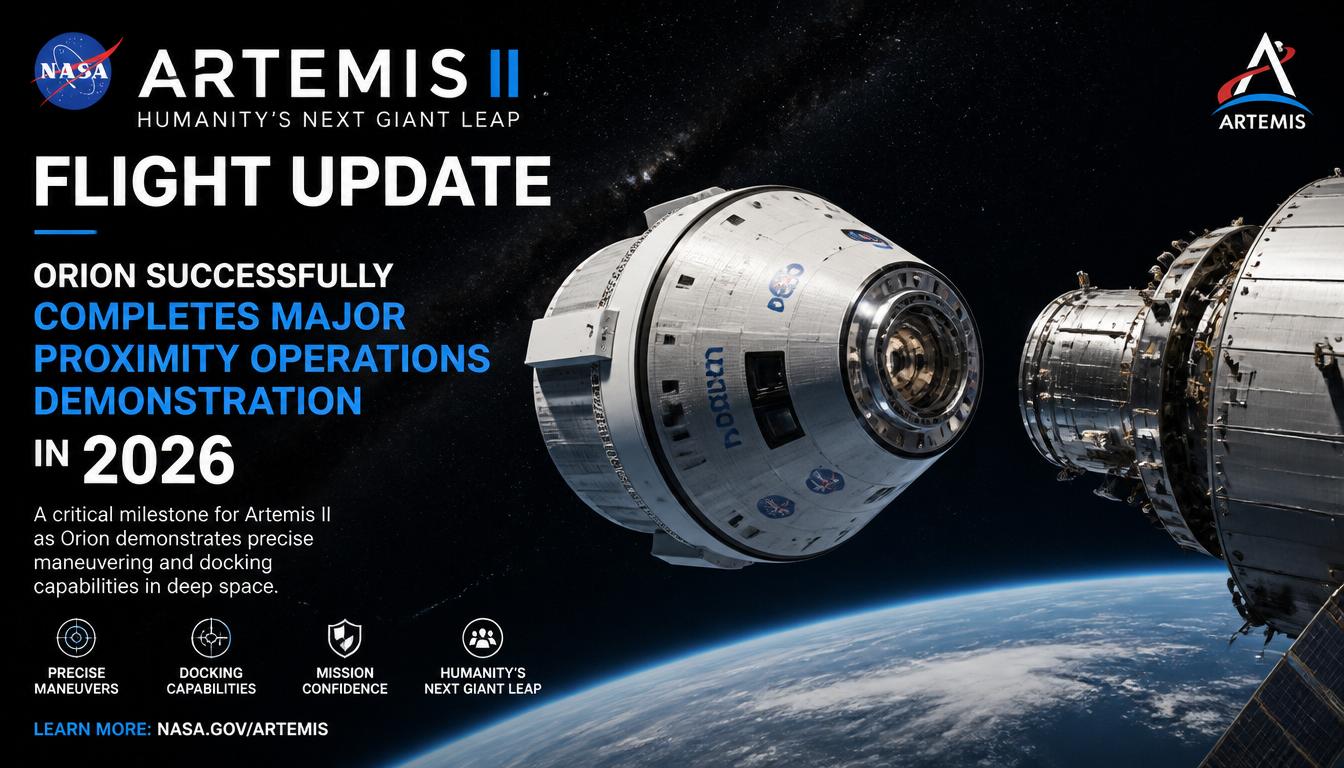
NASA’s Artemis II mission continues to move forward successfully as astronauts aboard the Orion spacecraft completed one of the mission’s most important early objectives — the Proximity Operations Demonstration. The successful test provided engineers with valuable information about how the Orion spacecraft performs during manual close-range maneuvering in space.
The demonstration marks another major achievement for the Artemis program as NASA prepares for future missions that will eventually return humans to the Moon and support long-term lunar exploration.
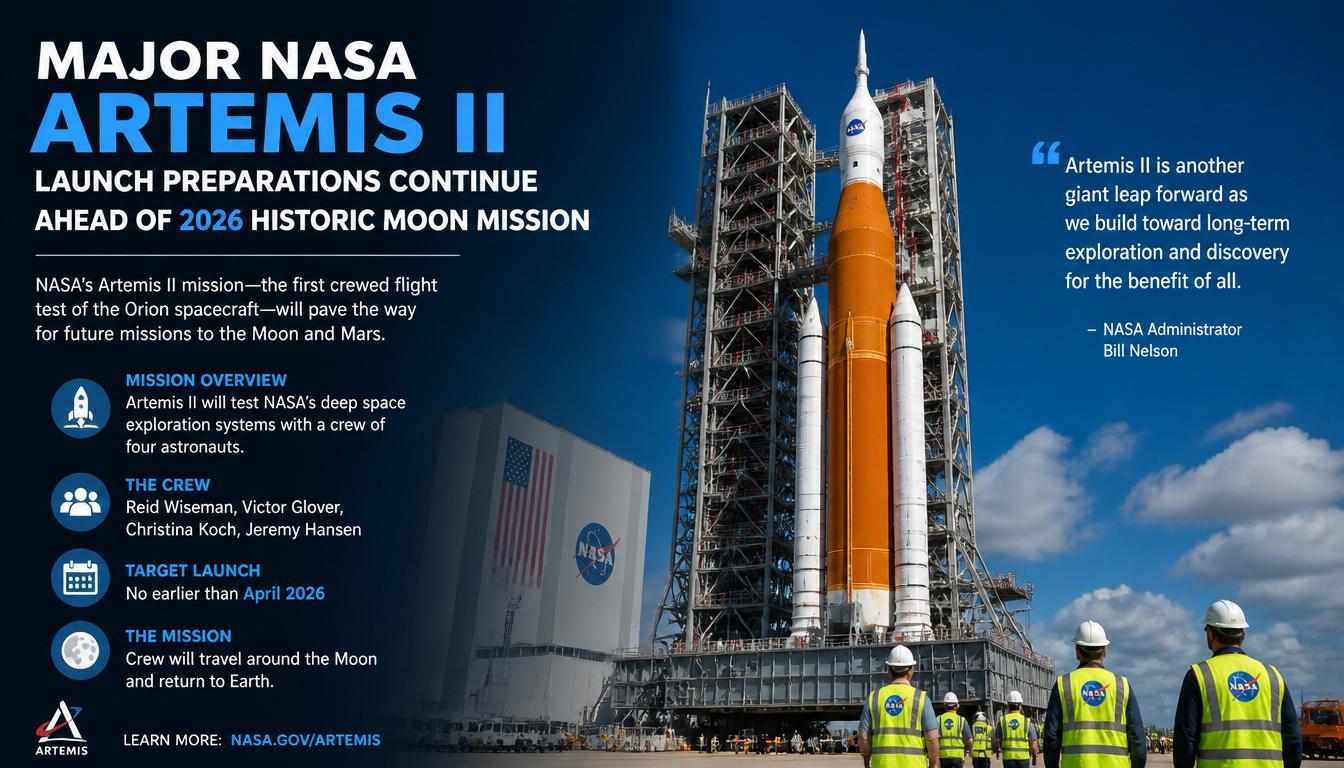
The Orion spacecraft, officially named “Integrity,” carried NASA astronauts Reid Wiseman, Victor Glover, Christina Koch, and Canadian astronaut Jeremy Hansen on a mission designed to test critical spacecraft systems and astronaut operations in deep space conditions.
Orion Successfully Performs Manual Space Maneuvers
The Proximity Operations Demonstration lasted approximately 70 minutes and tested Orion’s ability to safely maneuver near another spacecraft after separation.
During the operation, the Artemis II crew manually guided Orion around the detached Interim Cryogenic Propulsion Stage (ICPS), which served as a target object in space. Astronauts performed a series of carefully controlled approach and retreat maneuvers using Orion’s onboard navigation systems and reaction control thrusters.
The successful completion of these maneuvers demonstrates that Orion can safely perform delicate operations that will be essential during future Moon missions, including docking procedures and rendezvous activities in lunar orbit.
NASA engineers collected important flight data throughout the test to better understand how the spacecraft responds when astronauts take manual control during close-range operations.
Why the Proximity Operations Demonstration Matters
The proximity operations test is considered one of the most important parts of the Artemis II mission because future lunar missions will require astronauts to operate spacecraft near other vehicles and lunar stations.
Unlike missions in low Earth orbit, lunar missions cannot rely on GPS systems for navigation. This means spacecraft like Orion must depend on cameras, onboard sensors, navigation software, and astronaut piloting skills.
The successful demonstration helps NASA confirm that Orion’s navigation systems and manual controls work properly in real spaceflight conditions.
The data gathered during this operation will help improve spacecraft handling techniques for upcoming Artemis missions, including future lunar landing operations.
Orion Performs Automated Departure Burn
After the crew completed the manual maneuvering exercises, Orion executed an automated departure burn to safely move away from the ICPS stage.
This maneuver increased the distance between Orion and the upper stage to ensure safe separation before the ICPS carried out its own disposal operation.
NASA confirmed that the ICPS stage will eventually perform a disposal burn that will send it back into Earth’s atmosphere over a remote region of the Pacific Ocean. This controlled re-entry helps prevent space debris from remaining in orbit around Earth.
The successful departure burn also demonstrated Orion’s automated flight capabilities, which are essential for deep space travel.
Docking Camera Captures Important Navigation Data
During the entire demonstration, Orion’s docking camera system kept the ICPS stage in constant view and collected valuable positioning data.
The docking camera allowed engineers to study how accurately Orion could determine its relative position and movement while operating near another spacecraft.
These measurements are especially valuable for future Artemis missions because astronauts will eventually need to dock spacecraft near lunar stations, landers, and other vehicles in space.
NASA officials explained that the navigation data collected during Artemis II will help improve future spacecraft rendezvous systems and deep space navigation technologies.
CubeSats Launch Alongside Artemis II
In addition to the Orion spacecraft, four small satellites known as CubeSats were also launched during the Artemis II mission.
CubeSats are compact satellites roughly the size of shoeboxes, but they can carry powerful scientific instruments and technology experiments into space.
These CubeSats were stored inside the Orion stage adapter of the Space Launch System rocket and will be deployed into high Earth orbit after separation from the spacecraft.
Each CubeSat has a unique scientific mission designed to improve humanity’s understanding of the space environment.
ATENEA CubeSat Will Study Radiation and Communications
One of the CubeSats onboard Artemis II is called ATENEA, developed by the Argentina National Space Activities Commission.
The mission will study several important topics, including radiation shielding, orbital design optimization, and long-range communication systems.
Understanding radiation protection is extremely important for future astronaut missions beyond Earth orbit because deep space radiation can pose serious risks to both humans and spacecraft systems.
The information collected by ATENEA could help improve spacecraft safety for future lunar and Mars missions.
Saudi Arabia’s Space Weather CubeSat-1 Mission
Another CubeSat onboard Artemis II is Space Weather CubeSat-1, developed by the Saudi Space Agency.
This satellite is designed to study space weather conditions by measuring radiation, solar X-rays, solar energetic particles, and magnetic field activity.
Space weather can significantly affect spacecraft electronics, astronaut safety, and communication systems during deep space missions.
By studying these environmental conditions, scientists can better predict dangerous solar events and improve protections for future astronauts traveling beyond Earth.
Germany’s TACHELES CubeSat Technology Test
Germany’s Aerospace Center developed the TACHELES CubeSat to test important in-space technologies.
The mission focuses on demonstrating electrical components and systems that could one day support lunar logistics vehicles and Moon operations.
NASA and international space agencies are working toward establishing a long-term human presence on the Moon, and reliable technology systems will play a major role in those efforts.
Experiments like TACHELES help engineers evaluate how equipment performs in harsh space environments before being used on larger missions.
K-Rad Cube Studies Space Radiation Effects
The fourth CubeSat, K-Rad Cube, was developed by the Korea AeroSpace Administration (KASA).
Its mission is to measure radiation levels and study their biological effects while traveling through the Van Allen radiation belts surrounding Earth.
Radiation exposure remains one of the biggest challenges for long-duration human spaceflight. The information gathered by K-Rad Cube may help scientists develop better radiation protection systems for astronauts during future deep space missions.
NASA Continues Troubleshooting Orion’s Toilet System
Even though the majority of spacecraft systems are functioning as expected, the Artemis II crew and mission control teams are still looking into a minor problem related to the toilet system on board Orion. Earlier in the mission, astronauts noticed a blinking fault light during a routine system checkout. Engineers on the ground are currently analyzing spacecraft data and working closely with the crew to troubleshoot the problem.
NASA has not reported any major safety concerns related to the issue, but engineers are carefully monitoring the system to ensure normal spacecraft operations continue throughout the mission.
Perigee Raise Burn Scheduled Next
After completing the proximity operations demonstration, the Artemis II crew entered a scheduled rest period that included a four-hour nap.
NASA plans to wake the crew at 7 a.m. EDT on Thursday, April 2, to prepare for the next major maneuver known as the perigee raise burn.
This burn will increase the lowest point of Orion’s orbit around Earth. Combined with the earlier apogee raise burn, the maneuver helps shape Orion’s flight path and prepares the spacecraft for future translunar operations around the Moon.
These carefully planned orbital adjustments are critical for ensuring the spacecraft remains on the correct trajectory throughout the mission.
Artemis II Continues Building the Future of Lunar Exploration
The Artemis II mission represents one of NASA’s most important modern spaceflight programs. Every successful maneuver and system test helps prepare astronauts for future Moon missions and eventual human exploration of Mars.
By completing proximity operations, orbital burns, and spacecraft system tests, Orion continues proving that it is capable of supporting astronauts during deep space travel.
As the mission progresses, NASA engineers and astronauts will continue gathering important data that will shape the future of human space exploration for decades to come.
Frequently Asked Questions (FAQs)
What was the Proximity Operations Demonstration in Artemis II?
It was a test where astronauts manually maneuvered the Orion spacecraft near another object in space to evaluate navigation and handling systems.
What spacecraft was Orion maneuvering around?
Orion performed maneuvers around the detached Interim Cryogenic Propulsion Stage (ICPS).
Why is the proximity operations test important?
The test helps NASA prepare for future docking, rendezvous, and close-range spacecraft operations during lunar missions.
What happens to the ICPS stage after separation?
The ICPS will perform a disposal burn and re-enter Earth’s atmosphere over a remote part of the Pacific Ocean.
What are CubeSats?
CubeSats are small satellites designed for scientific research and technology experiments in space.
How many CubeSats launched with Artemis II?
Four CubeSats launched alongside the Artemis II mission.
What is the purpose of the perigee raise burn?
The perigee raise burn increases the lowest point of Orion’s orbit around Earth to help prepare for future translunar operations.
Is Orion experiencing any technical issues?
NASA is currently troubleshooting a blinking fault light related to Orion’s toilet system, but major spacecraft systems are operating normally.
read another articles
Keep exploring