Exciting Artemis II Flight Update: Orion Spacecraft Successfully Completes Major Apogee Raise Burn in 2026

Exciting Artemis II Flight Update: Orion Spacecraft Successfully Completes Major Apogee Raise Burn in 2026
NASA’s historic Artemis II mission continues to achieve major milestones as the Orion spacecraft successfully completed its important apogee raise burn while astronauts aboard the spacecraft prepare for the next critical stage of the mission. The mission represents another huge step toward returning humans to the Moon and preparing for future deep space exploration.
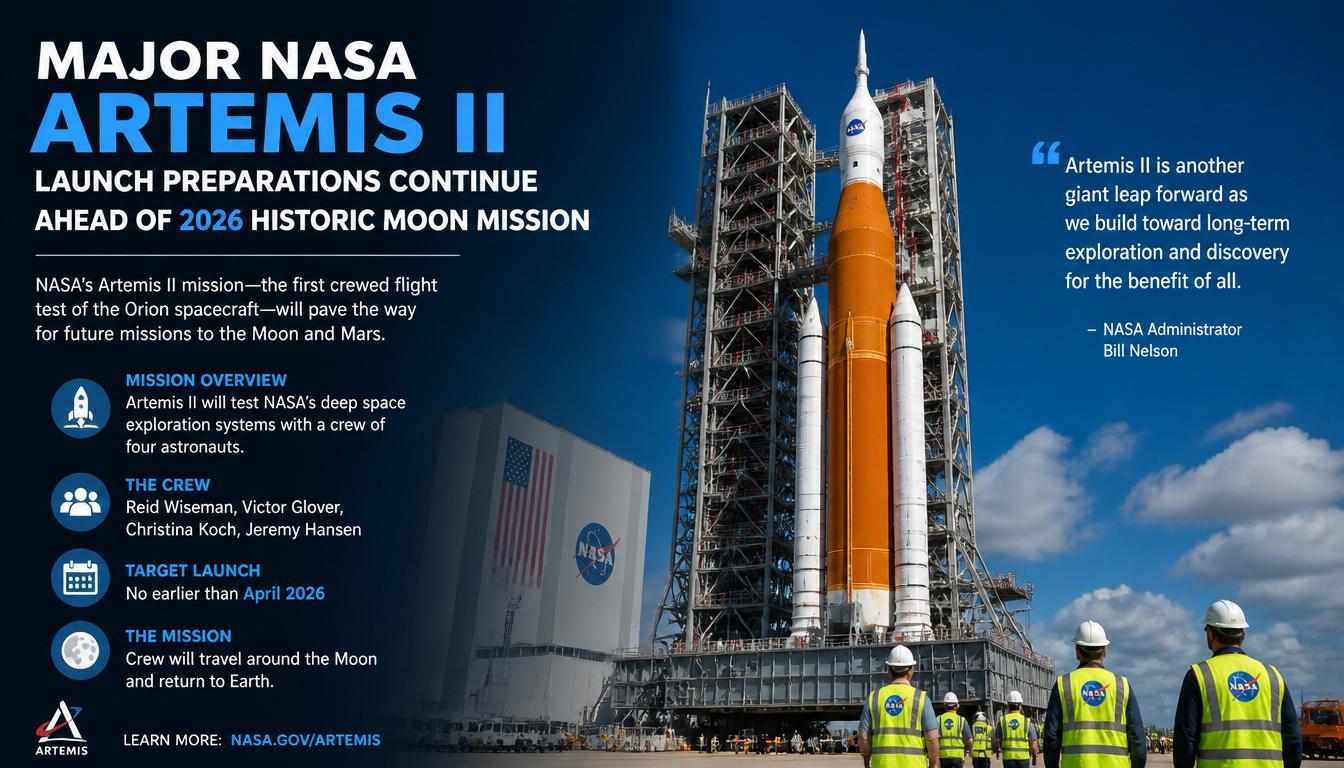
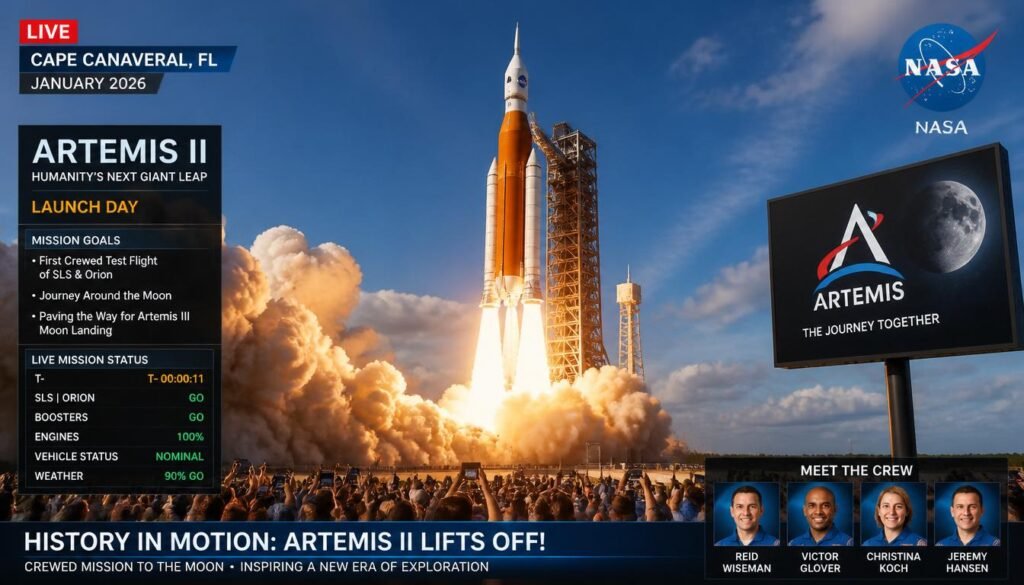
The Artemis II crew, made up of NASA astronauts Reid Wiseman, Victor Glover, Christina Koch, and Canadian astronaut Jeremy Hansen, launched aboard the Orion spacecraft on April 1, 2026, for an approximately 10-day journey around the Moon and back to Earth.
Orion Spacecraft Continues Smooth Mission Operations
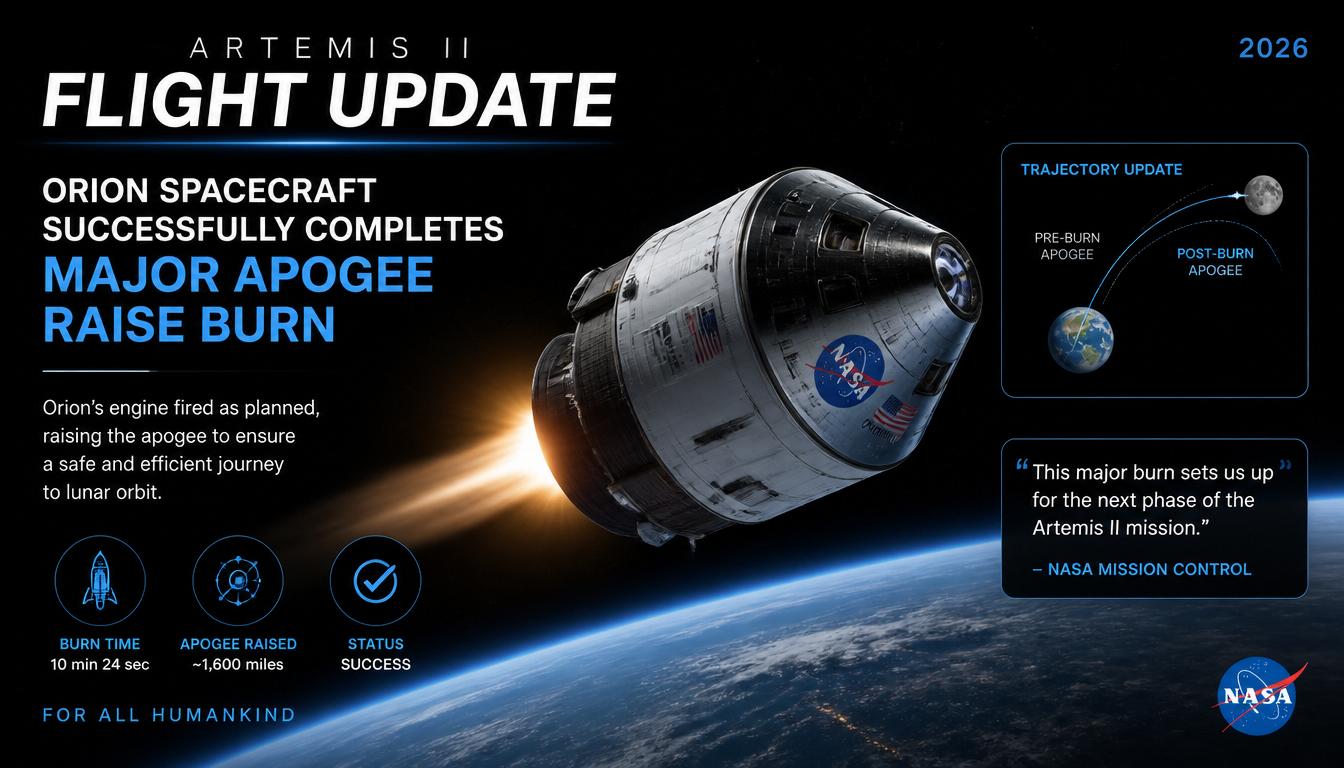
The Orion spacecraft is currently orbiting Earth as engineers and astronauts work together to prepare for the next mission activities. One of the latest achievements was the successful completion of the apogee raise burn, a maneuver designed to increase the highest point of Orion’s orbit around Earth.
This burn was performed by the Interim Cryogenic Propulsion Stage (ICPS), which used its powerful RL10 engine to carefully adjust Orion’s trajectory. The burn was executed with precise timing to ensure the spacecraft remains on the correct flight path for future operations.
NASA teams closely monitored the maneuver from mission control, and the spacecraft responded exactly as expected. The successful burn demonstrates the reliability of both the Orion spacecraft and the Space Launch System technology being tested during Artemis II.
Artemis II Crew Begins Adjusting to Life in Space
While the spacecraft systems continue operating normally, the crew has also started adapting to life in microgravity. Astronauts have been busy setting up the spacecraft cabin, checking onboard systems, and preparing equipment for the days ahead.
One of the early tasks included testing Orion’s onboard toilet system. During the checkout process, the crew noticed a blinking fault light and immediately informed mission control. Ground engineers are currently investigating the issue and working closely with the astronauts to determine the cause.
Although the issue appears minor, NASA teams are carefully reviewing all spacecraft systems to ensure the crew remains safe and comfortable throughout the mission.
Preparing for the Proximity Operations Demonstration
The next major event for the mission is the Proximity Operations Demonstration. This important test will allow astronauts to manually control the Orion spacecraft near another object in space.
The target for the demonstration will be the detached ICPS upper stage that helped launch Orion into orbit. NASA designed this test to evaluate how Orion performs when astronauts manually maneuver the spacecraft using onboard controls and navigation systems.
This demonstration is considered extremely important because future lunar missions will require spacecraft docking, rendezvous maneuvers, and close-range navigation near other spacecraft and lunar stations.
How Orion Will Perform Manual Maneuvers
During the demonstration, Orion — officially named “Integrity” — will carry out a series of controlled movements around the ICPS stage. The spacecraft will use navigation sensors and reaction control thrusters to carefully position itself in space.
The operation is expected to last approximately 70 minutes. After separating from the upper stage, Orion will perform an automated backflip maneuver so the crew can visually face the target stage.
Once Orion reaches a distance of around 300 feet, the spacecraft will stop relative motion, allowing astronauts to take manual control. Using hand controllers and onboard displays, the crew will guide Orion through a series of small movements to test the spacecraft’s handling capabilities.
These exercises help NASA understand how Orion behaves when controlled directly by astronauts in space conditions.
Fine Handling Tests Near the ICPS Stage
One of the most delicate parts of the demonstration will occur when Orion approaches within approximately 30 feet of the ICPS stage.
At this close distance, astronauts will evaluate the spacecraft’s fine handling qualities. Tiny adjustments will be made using the reaction control system thrusters located on Orion’s European Service Module.
These thrusters allow the spacecraft to make extremely precise movements in space. Engineers will carefully study the results of these tests because similar techniques will be required during future Moon missions and potential docking procedures in lunar orbit.
The demonstration also helps verify Orion’s navigation software, crew controls, and overall spacecraft responsiveness.
NASA’s Communication Networks Support the Mission
Before beginning the proximity operations test, Orion will switch communication support from NASA’s Near Space Network to the Deep Space Network.
These advanced communication systems work together to maintain constant contact with the spacecraft throughout the mission. From launch operations to deep space travel around the Moon, both networks play a vital role in transmitting data, voice communication, and navigation support.
The Deep Space Network is especially important for future lunar exploration because spacecraft operating far from Earth cannot rely on standard GPS technology.
Orion’s Docking Camera Will Collect Valuable Data
As Orion moves away from the ICPS stage after the demonstration, engineers will gather additional navigation data using the spacecraft’s docking camera.
The camera will capture highly accurate positioning measurements during Orion’s departure burn. NASA plans to use this information to improve future rendezvous and docking operations during upcoming Artemis missions.
This data becomes even more valuable because lunar space environments do not have GPS systems like Earth. Future astronauts will rely heavily on onboard sensors, cameras, and navigation systems to safely operate spacecraft near lunar stations and other vehicles.
Spacecraft Systems Continue Performing Well
According to NASA flight controllers, Orion’s major systems continue operating within expected limits.
The spacecraft’s solar array wings are successfully generating electrical power, and thermal systems are maintaining stable temperatures throughout the mission. Engineers have confirmed that the spacecraft remains in excellent condition as the crew prepares for the next mission phase.
NASA officials stated that the astronauts are safely configured for upcoming operations and that mission objectives continue progressing successfully.
Artemis II Represents a Major Step Toward Lunar Exploration
The Artemis II mission is much more than a simple test flight. It serves as a critical preparation for future missions that aim to return humans to the Moon for the first time in decades.
NASA plans to use lessons learned from Artemis II to support upcoming missions involving lunar landings, long-term Moon exploration, and eventually human missions to Mars.
The successful completion of maneuvers like the apogee raise burn and proximity operations demonstration proves that Orion and its systems are capable of supporting astronauts during deep space missions.
As the mission continues, space enthusiasts around the world remain focused on each milestone achieved by the Artemis II crew.
Frequently Asked Questions (FAQs)
The goal of the Artemis II mission is what?
Artemis II marks the first mission within NASA’s Artemis program that includes astronauts on board. Its goal is to test the Orion spacecraft and Space Launch System with astronauts onboard before future lunar landing missions.
What was the apogee raise burn?
The apogee raise burn was a planned engine firing performed by the ICPS upper stage to increase the highest point of Orion’s orbit around Earth.
Who are the astronauts on Artemis II?
The Artemis II crew includes NASA astronauts Reid Wiseman, Victor Glover, Christina Koch, and Canadian astronaut Jeremy Hansen.
What is the Proximity Operations Demonstration?
It is a test where astronauts manually maneuver the Orion spacecraft near another object in space to evaluate navigation and handling capabilities.
Why is the ICPS stage used during the demonstration?
The ICPS stage serves as a target for Orion to approach and maneuver around after separation from the rocket system.
How long is the Artemis II mission?
The mission is expected to last approximately 10 days, including a journey around the Moon and return to Earth.
Why is this mission important for future Moon missions?
Artemis II helps NASA test systems needed for future lunar landings, docking procedures, and long-duration deep space missions.
Is Orion operating normally during the mission?
Yes, according to NASA, Orion’s major systems, including power generation and thermal control, are performing within expected ranges.
read anothe articles
Keep exploring